Anthropic, the AI company behind Claude, confidentially filed for an IPO with the US Securities and Exchange Commission on 1 June 2026. Recent reports suggest the company could target a public listing as soon as mid-November 2026, although the ticker, final price and exact IPO date have not yet been confirmed.
Key facts
- IPO filing: Anthropic confidentially submitted a draft S-1 to the SEC on 1 June 2026.
- Potential IPO date: A listing is reportedly being targeted for as soon as mid-November 2026, but no official date has been confirmed.
- Investor event: Anthropic is reportedly scheduled to meet prospective institutional investors on 14 October 2026.
- Latest private valuation: $965 billion following its May 2026 Series H funding round.
- Reported IPO valuation: Around $2 trillion, although final terms have not been set.
- Reported potential raise: Up to $100 billion.
- Revenue: Annualised revenue reached around $65 billion by mid-2026 and has been reported to be on track to exceed $100 billion during 2026.
- Ticker: Not yet confirmed.
Table of Contents
- Anthropic at a glance
- What does Anthropic do?
- The IPO: date, valuation and what to expect
- Who controls Anthropic?
- IPO risks and controversies
- Why this IPO matters
- How to get exposure before the IPO
- How to trade Anthropic with Axi
- FAQ
Anthropic is the AI company behind Claude and is preparing for what could become one of the largest technology IPOs in history.
The company is now reportedly targeting a possible mid-November listing, after earlier plans for an October debut were pushed back. Anthropic is expected to meet prospective institutional investors on 14 October, while formal IPO marketing could begin as early as the week of 9 November.
The potential listing follows SpaceX's record-breaking June 2026 IPO and comes as investors apply increasing scrutiny to the valuations, infrastructure costs and profitability of rapidly growing artificial intelligence companies.
Anthropic at a glance
| Founded | 2021 |
| Founders | Dario Amodei, Daniela Amodei |
| Headquarters | San Francisco, California, USA |
| Full legal name | Anthropic PBC |
| Company type | Public Benefit Corporation |
| Primary product | Claude (AI assistant and API) |
| Annualised revenue | ~$65bn by mid-2026; reported to be on track to exceed $100bn during 2026 |
| Latest private valuation | $965 billion |
| Latest funding round | $65 billion (May 2026) |
| Key investors | Amazon, Google |
| Reported IPO valuation | ~$2 trillion |
| Reported potential IPO raise | Up to $100 billion |
| IPO filing date | 1 June 2026 (confidential) |
| Potential listing | As soon as mid-November 2026 |
| Ticker | TBC |
What does Anthropic do?
Anthropic was founded in 2021 by siblings Dario Amodei and Daniela Amodei, alongside former OpenAI colleagues. The team left OpenAI over disagreements about the safety and commercial direction of AI development, and Anthropic consequently focuses heavily on safety testing and cautious deployment.
The company's primary product is Claude, a family of AI models that competes directly with OpenAI's ChatGPT and Google's Gemini. Claude is distributed through a consumer chatbot, enterprise products and developer APIs.
Claude
Enterprise adoption has been the primary driver behind Anthropic's rapid revenue growth. Annualised revenue increased from roughly $9 billion at the end of 2025 to $47 billion by May 2026 and approximately $65 billion by July.
More recent reporting suggests Anthropic's annualised revenue could exceed $100 billion during 2026 as business adoption of Claude, particularly Claude Code and other workplace tools, continues to expand.
How Anthropic makes money
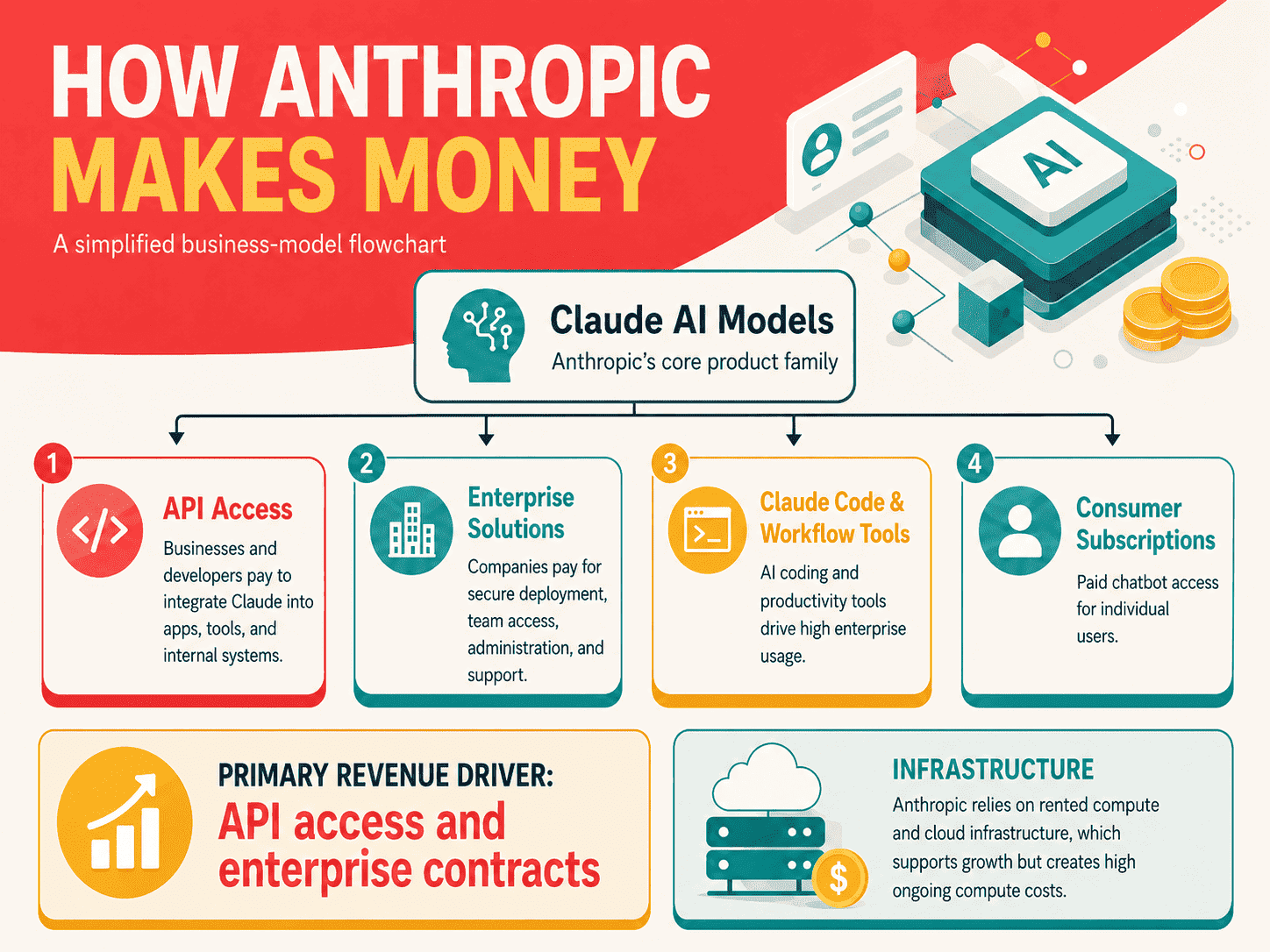
Anthropic generates revenue through API access, enterprise products, Claude Code and paid consumer subscriptions. Businesses in industries including finance, healthcare and legal services use Claude within their own applications and internal workflows.
In June 2026, California announced a statewide agreement making Claude the first AI productivity platform available across state agencies through its central technology procurement programme. The agreement also extends access to cities and counties.
Compute and infrastructure
Training and operating frontier AI models requires substantial computing capacity. Anthropic uses infrastructure from several major technology partners rather than relying solely on data centres that it owns itself.
The company has committed to spending more than $100 billion on AWS technologies over the next decade and has also expanded its compute partnerships with Google and Broadcom.
Anthropic also has access to computing capacity at xAI's Colossus infrastructure under a major cloud-services agreement, highlighting the scale of resources required to train and run frontier AI models.
The Public Benefit Corporation structure
Anthropic is structured as a Public Benefit Corporation. This requires the company to balance shareholder interests with its stated public-benefit mission around the responsible development and deployment of artificial intelligence.
For investors, this means commercial decisions may also be influenced by Anthropic's safety policies. That tension has already been visible in disputes with the US government over the permitted use of its AI models.
Anthropic IPO: date, valuation and what to expect
Anthropic confidentially submitted a draft registration statement on Form S-1 to the US Securities and Exchange Commission on 1 June 2026. Anthropic has confirmed that the number of shares to be offered and the IPO price have not yet been determined.
Earlier expectations centred on an October listing. More recent reporting suggests the company is now seeking to go public as soon as mid-November 2026, potentially beginning formal IPO marketing during the week of 9 November.
Anthropic is also reportedly planning a pre-IPO investor event at its San Francisco headquarters on 14 October 2026, giving prospective institutional investors an opportunity to meet senior management ahead of a potential listing.
Anthropic's May 2026 Series H funding round raised $65 billion at a $965 billion post-money valuation. Reports now suggest the company could seek to raise as much as $100 billion in its IPO at a valuation of around $2 trillion. These figures remain reported targets rather than confirmed IPO terms.
The AI valuation test
If Anthropic reaches a valuation close to the reported $2 trillion target, the IPO would value the company at more than twice its most recent private-market valuation only months after its Series H round.
The listing would therefore provide a major test of how public-market investors value rapidly growing generative AI companies and whether exceptional revenue growth can justify the industry's high infrastructure costs and valuations.
Anthropic's progress towards an IPO also puts it ahead of OpenAI in the public-listing process. OpenAI has reportedly pushed its own IPO plans further out while pursuing additional private financing.
Who controls Anthropic?
Control remains concentrated within Anthropic's founding team, which retains significant influence over the company's direction. Dario Amodei serves as CEO and Daniela Amodei as President, while Amazon and Google are among the company's largest outside investors.
Full details on voting rights, share classes and post-IPO ownership are expected to become available when Anthropic publicly files its IPO prospectus.
Amazon's stake
Amazon is one of Anthropic's largest strategic investors and cloud-computing partners. Recent reporting indicates that Amazon has invested approximately $18 billion in Anthropic, with its total commitment potentially reaching around $33 billion.
The commercial relationship is also substantial. Anthropic has committed to spending more than $100 billion on AWS technologies over the next decade and uses Amazon's Trainium chips and cloud infrastructure to train and deploy Claude.
Google's stake
Alphabet, Google's parent company, holds a substantial minority stake in Anthropic. Its ownership has been reported at approximately 14%, with a contractual cap of 15%.
In April 2026, Google agreed to invest up to an additional $40 billion in Anthropic, including $10 billion upfront with the remainder tied to future milestones.
Google is both a partner and a competitor. It provides Anthropic with cloud infrastructure and custom AI chips while simultaneously developing Gemini, which competes directly with Claude.
IPO risks and controversies
An IPO of this size carries significant risks. Traders considering exposure to Anthropic should weigh several factors.
Valuation scepticism
Anthropic's $965 billion private valuation has already attracted criticism from investors who question whether current AI valuations can be sustained relative to profitability and the cost of the infrastructure required to build frontier models.
A reported IPO valuation of around $2 trillion would raise the bar considerably further, meaning public investors would be placing a high value on Anthropic's ability to maintain rapid growth for many years.
The path to profitability
Training frontier AI models and operating them at large scale requires significant spending on chips, data centres, energy and cloud infrastructure.
There are signs of improving operating economics. Anthropic has reportedly told investors that it expects adjusted operating income to be positive for a second consecutive quarter, excluding stock-based compensation. However, the company's long-term profitability will still depend on revenue growth continuing to outpace its substantial infrastructure and research costs.
US government tensions
Anthropic's relationship with the US government has experienced turbulence. In March 2026, the Pentagon designated Anthropic a supply-chain risk following disagreements over restrictions on using its models for autonomous weapons and mass surveillance. Anthropic subsequently challenged the government's actions.
For investors, the dispute illustrates a broader structural issue: Anthropic's safety commitments may at times restrict the commercial uses it is willing to support, including contracts with major government customers.
Regulatory and competitive risk
Governments across the US, Europe and other markets continue to develop new rules for artificial intelligence, and future regulation could affect how Anthropic develops, distributes and monetises its most capable models.
Anthropic also competes with heavily funded rivals including OpenAI, Google and Meta, all of which continue to invest aggressively in frontier AI models and infrastructure.
Why this IPO matters
Anthropic's listing could become one of the first occasions on which public markets directly value a major pure-play frontier AI company.
The company's revenue growth illustrates why the listing is attracting so much attention. Annualised revenue rose from around $9 billion at the end of 2025 to approximately $65 billion by July 2026, with more recent reports suggesting it could exceed $100 billion during 2026.
Investors will therefore be assessing whether this exceptional growth can justify a reported valuation target of around $2 trillion while also accounting for Anthropic's large and continuing spending requirements.
SpaceX's record June IPO has also raised the stakes for the next generation of mega-listings. Its highly volatile post-IPO trading has reinforced the importance of pricing and valuation as Anthropic prepares to approach public investors.
A successful Anthropic listing could strengthen investor confidence across AI-related shares and semiconductor companies. Conversely, weak demand or significant post-listing volatility could put pressure on valuations across the wider AI sector.
Axi Market Analyst Milan Cutkovic noted:
“Anthropic's upcoming IPO will be the next major test for the AI-fuelled stock market rally, and potentially a make-or-break moment. Investors are right to question the company's massive compute costs and path to profitability, but Anthropic has posted rapid enterprise adoption and revenue growth, and it enjoys backing from major players like Amazon and Google, making it likely that the IPO will keep the hype alive and propel US stocks to fresh record highs.”
How to get exposure before the IPO
Because Anthropic remains privately held and its ticker and listing date have not yet been confirmed, direct market exposure to Anthropic is not currently available.
Traders can, however, gain indirect exposure to developments around Anthropic through publicly traded companies that hold major investments in the business, including Amazon and Alphabet.
Amazon and Alphabet's Anthropic exposure
| Factor | Amazon (AMZN) | Alphabet (GOOGL) |
| Anthropic investment | Approximately $18bn invested; further commitments reported | Approximately 14% stake; up to $40bn additional investment committed |
| Relationship | Investor and major AWS infrastructure partner | Investor, infrastructure partner and AI competitor |
| Infrastructure | Anthropic has committed more than $100bn to AWS technologies over ten years | Google provides cloud and TPU computing capacity |
| AI competition | Primarily a strategic partner | Also competes with Anthropic through Gemini |
Neither Amazon nor Alphabet provides pure exposure to Anthropic. Their share prices are driven primarily by their own much larger businesses and can move independently of changes in Anthropic's valuation.
Both Amazon and Alphabet shares are available to trade as CFDs with Axi.
How to trade Anthropic with Axi
When Anthropic lists and prices become available from our liquidity providers, you will be able to trade Anthropic CFDs directly on Axi. Until then, AMZN and GOOGL are available to trade now.
All clients will be able to start trading Anthropic from the date of listing. At launch, only long positions are likely to be available, meaning you can buy Anthropic but not short it in the initial trading period.
- Log in to your live trading account (or open an account with Axi if you don't have one yet).
- Navigate to Market Watch, right-click, and select 'Show All'. Search for Anthropic or its ticker on the Axi Trading Platform (Web or Mobile), or find it directly on MT5.
- Choose your position size, set your stop-loss and take-profit orders, and enter the trade.
Trading CFDs carries a high risk of losing money rapidly due to leverage. You should consider whether you understand how CFDs work and whether you can afford to take the high risk of losing your money.
FAQ
When is the Anthropic IPO date?
Anthropic confidentially filed with the SEC on 1 June 2026. Recent reports suggest it is targeting a potential listing as soon as mid-November 2026, with formal IPO marketing potentially beginning during the week of 9 November. No official IPO date has yet been announced.
What valuation is Anthropic targeting for its IPO?
Anthropic's May 2026 Series H funding round valued the company at $965 billion. More recent reports suggest the company may seek an IPO valuation of around $2 trillion, although the final valuation and offering terms have not yet been confirmed.
How much could Anthropic raise in its IPO?
Reports suggest Anthropic could seek to raise as much as $100 billion in its IPO. The final number of shares and offering price have not yet been set.
What is Anthropic's ticker symbol?
Anthropic's ticker symbol has not yet been confirmed. It is expected to be disclosed when the company makes its public IPO filings.
Can I trade Anthropic CFDs before the IPO date?
Not directly. Anthropic is still privately held, so there is currently no publicly traded Anthropic share on which a CFD can be based. Eligible traders can instead gain indirect exposure through CFDs on publicly listed investors such as Amazon or Alphabet.
Is Anthropic profitable?
Anthropic has not publicly disclosed GAAP net-profit figures. However, recent reporting indicates the company expects adjusted operating income to be positive for a second consecutive quarter, excluding stock-based compensation. At the same time, training and operating frontier AI models continues to require very high infrastructure spending.
How does Anthropic compare to OpenAI?
Anthropic and OpenAI are two of the largest companies developing frontier generative AI models. Anthropic's latest confirmed private valuation is $965 billion and it has already confidentially filed for an IPO. OpenAI remains privately held and has reportedly pushed its own potential public listing further out while pursuing additional private funding.
Sources
- Anthropic: Confidential draft S-1 submitted to the SEC
- Anthropic: $65bn Series H at a $965bn valuation
- Anthropic: Expanded Amazon compute collaboration
- State of California: Anthropic partnership
- Bloomberg: Anthropic targets potential November IPO
- Bloomberg: Anthropic plans pre-IPO investor day
Ready to trade your edge?
Join thousands of traders and trade CFDs on forex, shares, indices, commodities, and cryptocurrencies!
This information is not to be construed as a recommendation; or an offer to buy or sell; or the solicitation of an offer to buy or sell any security, financial product, or instrument; or to participate in any trading strategy. It has been prepared without taking your objectives, financial situation and needs into account. Any references to past performance and forecasts are not reliable indicators of future results. Axi makes no representation and assumes no liability with regard to the accuracy and completeness of the content in this publication. Readers should seek their own advice.

Santiago Vazquez Munoz
I’m Santiago Vazquez Munoz, a global commercial leader with a career built across banking, financial services, fintech, sales and international growth.
Over the years, I’ve had the opportunity to build and lead businesses and teams across Europe, Latin America, APAC ,EMEA and other international markets. That experience has taught me that sustainable growth is rarely about one great idea. It comes from understanding markets, building the right teams, making disciplined decisions and, above all, executing consistently.
Today, my work sits at the intersection of global sales leadership, P&L management, commercial strategy, governance and business scaling. I’m particularly interested in what happens when strategy meets reality: entering new markets, leading multicultural teams, creating accountability, navigating change and turning ambitious growth plans into measurable results.
This blog is where I share some of those lessons, along with my perspective on leadership, international business, fintech, sales, execution and the realities of scaling organizations across countries and cultures.
I believe strongly in focus, leverage, accountability and execution. But I also believe leadership is a continuous learning process, and many of the most valuable lessons come from the decisions that didn’t work exactly as planned.
My goal here is simple: to share practical ideas oriented to age of AI in Trading, experiences and observations that may help other traders, leaders, entrepreneurs, and commercial teams think differently about growth and execute better