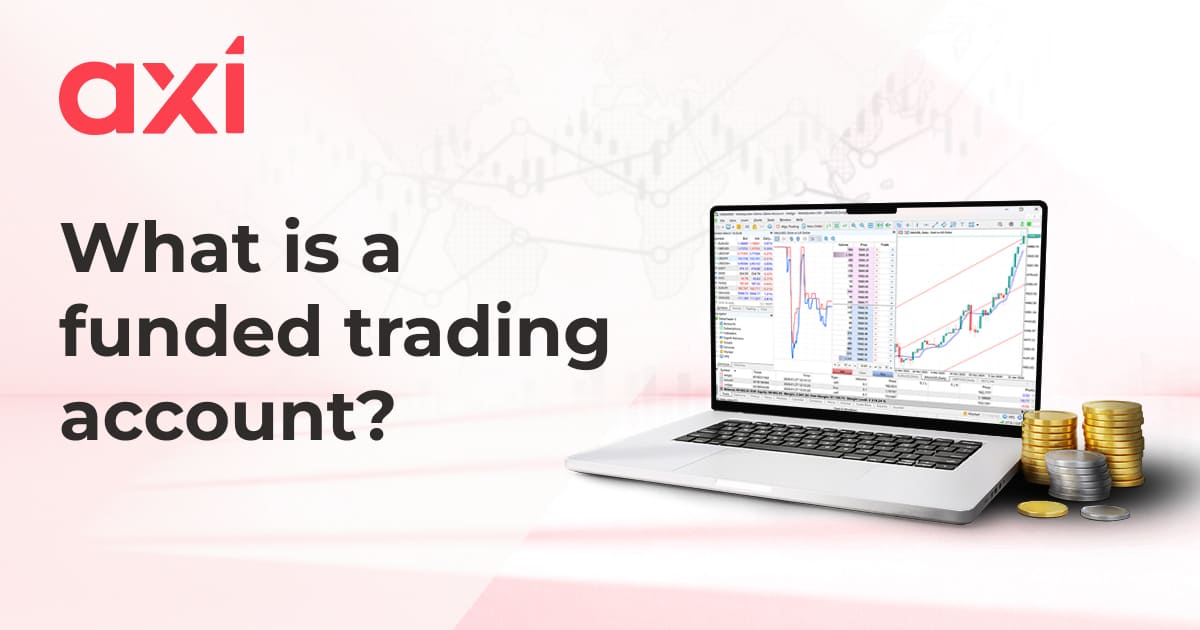
A funded trading account gives a trader access to capital provided by a third party, usually a proprietary trading firm or, in some cases, a broker program. Instead of trading only their own money, the trader uses allocated capital under a set of rules and typically shares a portion of any profits earned.
For many aspiring traders, funded accounts offer a way to access larger buying power without making a large upfront deposit. But they also come with strict requirements, risk controls and performance expectations. This article will break down what a funded trading account is, how it works, and how to get one.
What is a funded trading account?
A funded trading account is a trading account backed by capital from a provider rather than entirely by the trader. In most cases, the trader must prove they can trade responsibly and profitably before they are allowed to manage that capital.
In simple terms, a funded account allows a trader to trade bigger than they could with their personal funds alone. The main purpose is to give skilled traders access to more capital while limiting the provider's risk through rules, evaluation stages and account protections.
Funded trading accounts are typically offered by proprietary trading firms, often called prop firms. Some brokers also offer trader development or capital allocation programs tied to their own ecosystem.
What is a funded trader?
A funded trader is a trader who has been given access to third-party capital to trade, usually after meeting performance or evaluation requirements set by a prop firm or broker-backed program.
How do funded accounts work?
Funded accounts generally follow a straightforward model: a provider sets rules, the trader demonstrates their skill in the markets, and the trader may then receive access to capital in exchange for following the program terms.
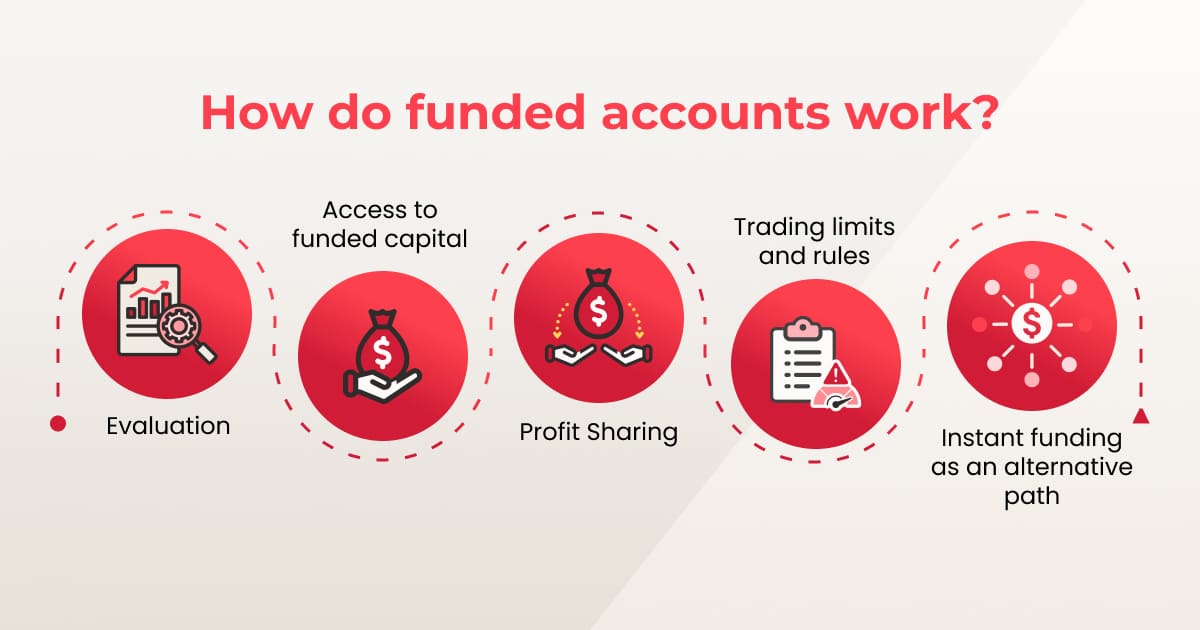
Evaluation
Many funded account programs start with an evaluation phase. During this stage, the trader usually works toward specific goals, such as reaching a profit target while staying within daily drawdown, maximum loss, or consistency limits.
The evaluation is designed to test more than profitability. It also measures discipline, risk management and the ability to follow rules when under pressure.
Profit sharing
Once funded, traders usually keep a percentage of the profits they generate, while the provider keeps the rest. This is known as a profit split or profit-sharing model.
The exact percentage varies by provider. Some programs offer higher trader payouts as performance improves or as the trader moves to larger account tiers.
Trading limits and rules
Funded accounts almost always come with restrictions. These may include:
- Maximum daily loss
- Maximum total drawdown
- Position size limits
- Restrictions on holding trades through certain events
- Minimum or maximum trading days
- Rules around consistency or risk concentration
These limits are a core part of the model. They are meant to protect the firm's capital and encourage disciplined trading behaviour.
Instant funding
Some providers advertise instant funding. This usually means a trader can access a funded account without completing a traditional evaluation challenge first.
That does not mean there are no rules. Instant-funded accounts still tend to have strict drawdown rules, trading restrictions and eligibility requirements. Often, the trader pays a higher upfront fee or accepts tighter conditions in exchange for skipping the evaluation phase.
How to get a funded trading account
Getting a funded trading account usually involves choosing a provider, meeting its requirements and showing that you can trade within its rules. Most funded trading accounts are provided by proprietary trading firms, so it is important to understand how prop trading works before applying.
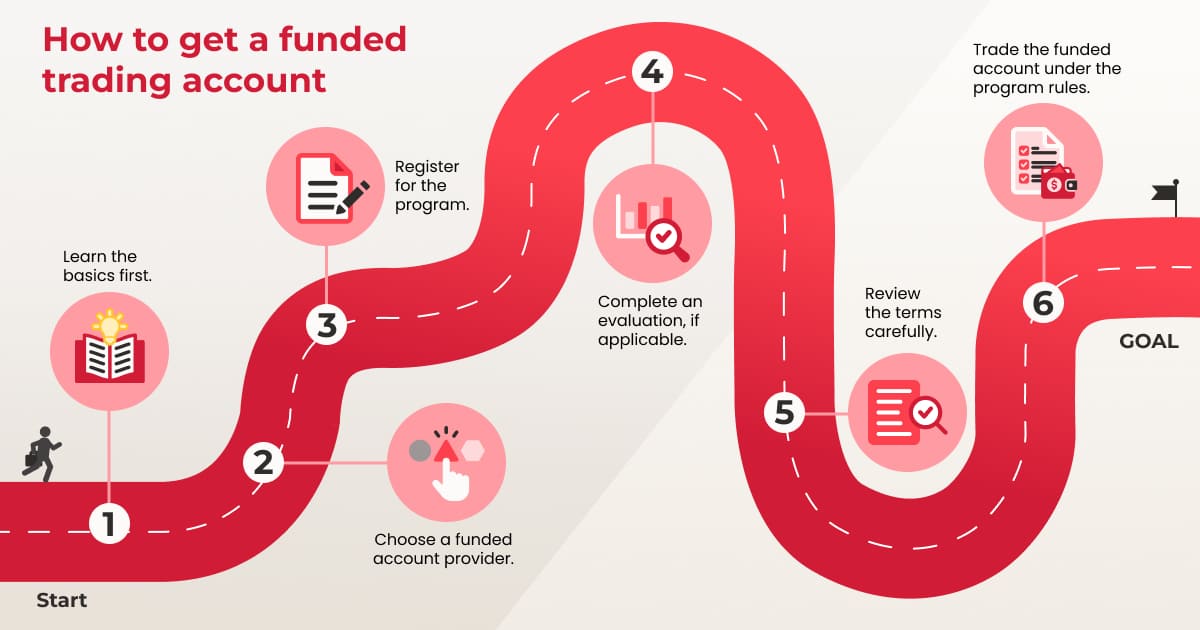
A typical process looks like this:
- Learn the basics first. Before trying for funding, traders should understand markets, order execution, leverage, risk management and trading psychology. If you are still building your skills, practising on a demo account can help you develop consistency without risking real money.
- Choose a funded account provider. Compare prop firms and broker-backed programs based on regulation, reputation, fees, assets, profit split, withdrawal terms and trading rules.
- Register for the program. This usually includes creating an account, verifying your identity (if required) and selecting an account size or challenge type.
- Complete an evaluation, if applicable. Many providers require traders to hit profit targets without breaching risk limits.
- Review the terms carefully. Before accepting a funded account, make sure you understand the payout structure, restrictions, loss limits, as well as any account reset or inactivity policies.
- Trade the funded account under the program rules. Continued access to capital depends on maintaining discipline and staying within the provider's risk framework.
Funded vs. regular trading accounts
The biggest difference between a funded account and a regular trading account is whose capital is being used.
With a regular trading account, the trader deposits and risks their own money. They keep any profits but also absorb any losses directly.
With a funded account, the capital is provided by a third party, with which the trader typically shares profits. This allows the trader to access more capital than they could personally afford, provided they adhere to the firm's specific rules.
Regular accounts generally offer more freedom. Funded accounts may offer more leverage in terms of capital access, but they also involve more oversight and restrictions.
Funded account with a regulated broker vs. prop firms
Most funded trading accounts come from prop firms, but some traders may prefer programs connected to regulated brokers. The difference matters.
A traditional prop firm usually specialises in evaluating traders and allocating capital under an internal model. These firms may offer attractive profit splits and fast-track options, but the structure, fees and oversight can vary significantly from one firm to another.
A funded account program linked to a regulated broker may appeal to traders who value established infrastructure, clearer operational standards and a more recognisable brand environment.
Feature |
Funded account with a regulated broker |
Funded account with a prop firm |
Registration Fee |
No | Yes |
Pass Evaluation |
No | Yes |
Restrictive Trading Conditions |
No | Varies |
Number of Attempts |
3 | 1 |
Leverage |
Up to 1000:1 | Varies, majority less than 100:1 |
Account Type |
Real trading account | Demo |
Additional Tools |
Dashboard/Leaderboard, Edge Score, Trading Room | Varies |
Who should consider a funded account?
A funded account may be worth considering for traders who have developed trading strategies, can consistently manage risk and want access to more capital without making a large personal deposit.
It can also suit traders who want a structured environment with clear performance rules. For some, those rules improve discipline. For others, the restrictions may feel limiting.
In general, funded accounts tend to be better suited to traders who already have a repeatable process rather than complete beginners who are still learning the basics.
Risks of funded accounts
Funded accounts can create opportunity, but they also come with real risks.
One major risk is rule violation. A trader may be profitable overall and still lose the account by breaching a daily drawdown or position-sizing rule.
Another risk is cost. Some programs charge entry fees, recurring platform fees or reset fees. Traders should make sure they understand the full cost structure before signing up.
There is also performance pressure. Trading under evaluation or with strict limits can affect decision-making, especially for newer traders. Often, the rush to clear an evaluation leads to the kind of impulsive risk-taking that ends up doing more harm than good.
Finally, not all providers are equal. Terms, transparency and operational quality vary widely, which makes due diligence before entering one of these programs essential.
How to choose a funded account program
Choosing a funded account program starts with the rules, but it shouldn't end there.
Look closely at the provider's reputation, transparency, and track record. Read the program terms carefully and pay attention to fees, payout conditions, drawdown rules, platform choices and instrument availability.
It is also important to consider the type of company behind the offering. Some traders may prefer a broker-backed pathway because of the firm's broader market presence and infrastructure.
A good funded account program should offer clear rules, fair evaluation criteria, realistic conditions and a provider you feel confident dealing with over time.
Conclusion
A funded trading account is a way for traders to access third-party capital instead of relying only on their own funds. In most cases, the trader must prove they can trade profitably and responsibly, then follow strict risk rules in exchange for a share of the profits.
For the right trader, a funded account can provide a path to bigger opportunity and more capital efficiency. But it is not a shortcut. Success depends on preparation, discipline, and choosing the right provider.
Whether you are comparing prop firms or researching how funded programs work, the key is to understand the rules before you start.

Alex Macris
With a background spanning forex, stocks, and crypto, Alex has contributed financial and stock exchange reports to leading publications and news agencies. Beyond financial markets, he honed his skills by researching and editing international agreements and state reports and producing multimedia resources for diverse brands and organisations.
In addition to written content, Alex, who is fluent in English, French, and Greek, brings extensive experience and passion for audio. His portfolio showcases a versatile skill set encompassing podcast production, educational materials, and advertisements. A team player and lifelong learner, he maintains a balanced perspective on both the big picture and the finer details.
Find him on: LinkedIn