1. Understanding AI, machine learning and LLMs
Artificial intelligence (AI), machine learning (ML) and large language models (LLMs) are closely related technologies, but they serve different purposes. Each builds on the capabilities of the broader category.
| Technology | What it is | How it helps in trading |
|---|---|---|
| Artificial intelligence (AI) | The broad field of technology that lets computers handle tasks associated with human intelligence, such as problem-solving and decision-making. | Powers automated systems, market analysis, and decision-support tools. |
| Machine learning (ML) | A subset of AI that identifies patterns and makes predictions without relying on explicitly programmed rules. | Great for analysing historical prices, spotting patterns and forecasting volatility. |
| Large language models (LLMs) | A type of advanced machine learning that uses deep learning to understand, process and generate human language. | Ideal for summarising financial news, interpreting reports, and answering plain-language questions. |
Keep in mind that not all AI trading systems use machine learning, and not all machine learning systems are LLMs.
2. How does AI trading work?
AI trading works by processing large amounts of market data, surfacing patterns, and turning them into practical insights. The process typically involves the following stages, although not every tool uses all five.
| Stage | What AI does | What traders should watch for |
|---|---|---|
| 1. Data collection and processing | Analyses historical and real-time prices, trading volumes, economic releases, financial news and account data. | Outdated or inaccurate data can produce misleading results. |
| 2. Market analysis and pattern recognition | Identifies trends, relationships and potential trade set-ups. Tools like Ask Axi help you explore these insights and assess portfolio exposure. | Past patterns don't always repeat when market conditions shift. |
| 3. Strategy validation | AI helps with backtesting strategies against historical data and evaluating them against fresh data. | Overfitting can make a strategy appear successful on paper without performing well in live markets. |
| 4. Generating insights and trading signals | Depending on the tool, produces market summaries, forecasts, trading signals or potential entry and exit level. | Language models can sound completely confident while serving up incorrect information. |
| 5. Decisions and execution | Supports manual trading decisions, trader-approved execution or automated trading. For instance, Axi MCP connects Claude to an MT5 account so you can pull live data and manage trades with your approval. | Spreads, slippage, technical failures and incorrect instructions can affect your expected execution. |
3. How is AI used in trading?
Rather than replacing traditional trading methods, AI can help traders process more information and handle repetitive tasks.
AI applications in trading strategies
| Trading strategy | How AI can be used |
|---|---|
| Trend following and momentum trading | Quickly screen multiple instruments for emerging trends and shifting momentum. |
| Breakout trading | Examine past volatility and volume to assess the likelihood of a breakout continuing or failing. |
| Range and mean-reversion trading | Analyse historical price behaviour to spot deviations from established trading ranges and assess potential reversals. |
| News and event trading | Summarise central bank announcements, earnings reports and economic releases, and compare them against market expectations. |
Note: These are classic trading strategies that simply get an efficiency boost from AI. You can dive deeper into the underlying mechanics using Axi's guide to day trading strategies.
Practical example: Using AI to analyse Natural Gas
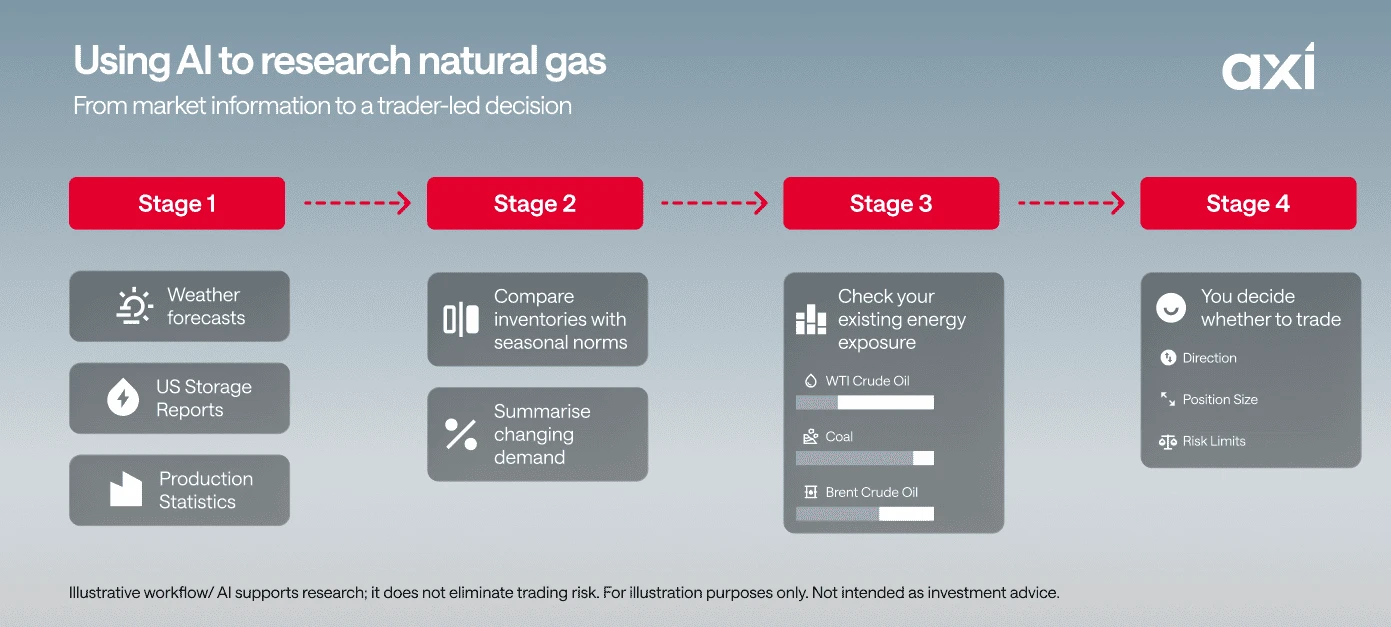
Imagine you are looking at Natural Gas perpetual futures. You can use AI to pull together weather forecasts, US storage reports, and production statistics. The AI helps compare current inventories with seasonal norms and summarises how demand is shifting. You can then check your existing energy exposure using portfolio analytics. The ultimate call (direction, size, and risk limits) remains entirely yours.
Portfolio analysis and risk management
Beyond finding new opportunities, AI is excellent at helping you understand the positions you already hold. Ask Axi supports portfolio analysis, including performance and exposure, while Axi MCP lets Claude fetch live MT5 account information, like open positions, equity and trading history.
Strategy development and backtesting
AI can write code, draft trading rules, and crunch historical results. If you are testing a breakout model, you can use AI to cycle through different entry triggers and volatility filters. Just remember that strong backtests are never a guarantee of future profits.
4. Who is in control? Three modes of AI trading
Not all AI tools have the same level of access to your account. It helps to categorise them by what they can do on their own and how much authority you keep:
| Mode | What the AI does | Who decides | Account access | Examples |
|---|---|---|---|---|
| Informs | Explains market news, evaluates portfolio performance, and breaks down exposure. | The trader | None or read-only | Ask Axi, Axi MCP read-only tools, general AI assistants |
| Proposes | Identifies potential setups, signals, or key price levels. | The trader decides whether to act. | Usually none or read-only | AI signal generators and pattern recognition tools |
| Acts | Places, modifies or closes orders based on rules or instructions. | Supervised (you approve) or Autonomous (the system follows its rules or models). | Trading permissions | Axi MCP with Claude (approval required), trading bots |
The line between supervised and autonomous execution is important. With supervised systems like Axi MCP with Claude, you must approve each trading action. Autonomous systems, including conventional Expert Advisors (EAs) and AI-powered bots, can execute trades according to their configuration without requiring individual approval.
More automation does not necessarily mean smarter AI. A rules-based EA may trade automatically, while an AI-powered assistant may only provide analysis or require approval before taking action. In every case, traders remain responsible for understanding the tools they use and managing trading risk.
5. From automated trading tools to AI-powered trading
Trading technology has evolved from rigid automation and market scanners to conversational AI tools that connect directly with your trading account.
Axi's trading toolkit reflects this evolution, offering everything from established automated systems to modern AI capabilities. Each tool serves a distinct purpose, letting you combine technologies based on your strategy, analytical needs, and preferred level of automation.
Expert Advisors: Rules-based trading automation
Expert Advisors (EAs) are automated trading programs available through MetaTrader 4 (MT4) and MetaTrader 5 (MT5), both supported by Axi.
EAs monitor market conditions and can execute or manage trades according to predefined rules. For example, an EA might automatically open a position when two moving averages cross and close it when specified exit conditions are met.
Most traditional EAs are rules-based rather than AI-powered, although some can incorporate machine learning models. Their advantage lies in executing predefined strategies consistently without requiring you to monitor every market movement.
Autochartist: Automated market analysis
Autochartist is an automated technical analysis tool available to eligible Axi traders. It continuously scans financial markets for chart patterns, key price levels and potential trading set-ups.
Instead of requiring you to manually examine numerous charts, Autochartist highlights developing patterns, helping you focus on your analysis.
Unlike EAs, Autochartist does not execute trades automatically. Its purpose is to support your technical analysis and alert you to potential opportunities, leaving trading decisions up to you.
Ask Axi: AI-powered trading analysis
Ask Axi is Axi's dedicated AI trading analyst, designed to help you interpret market data and understand your trading activity through natural-language interaction.
It allows you to analyse portfolio performance, assess risk exposure, explore market insights, and compare financial instruments just by asking.
Unlike conventional pattern-recognition tools, Ask Axi lets you investigate markets through plain-language questions rather than relying exclusively on charts or rigid analytical outputs.
Ask Axi supports research and decision-making but does not provide direct trading signals or personalised financial advice.
Axi MCP with Claude: AI-connected trading
The Axi MCP integration connects Claude, an AI assistant developed by Anthropic, to eligible Axi MetaTrader 5 accounts through Model Context Protocol (MCP).
MCP is an open standard that enables AI assistants to connect with external applications and data sources. In trading, this allows Claude to retrieve live account information and interact with supported trading functions using everyday language.
You can check account balances, retrieve live prices, review open positions, analyse trading history, and request actions such as placing, modifying, or closing orders.
For example, a trader could ask Claude to summarise recent trading performance, including commissions and swap fees, or request a change to an existing stop-loss level.
Unlike fully automated trading bots, Axi MCP requires your explicit approval for every trading action. Access to account information and trading functions is managed through separate permissions.
Related reading: What is MCP in trading?
Expert perspective
Axi Market Analyst Milan Cutkovic says:
“In my view, AI has taken a lot of the legwork out of market preparation, so going through central bank statements or checking a dozen markets before the open now takes minutes rather than hours. It still has trouble reading how a market behaves in real time, for example when a data release surprises or when too many traders are on the same side, and that’s why charts, the economic calendar and a solid risk plan haven’t lost their value. I see AI as a useful second opinion, but the decision to place a trade should still come down to the trader’s own judgement."
From rules-based automation to AI-connected trading, these technologies serve different purposes rather than replacing one another. Traders can combine them according to their strategies, analytical needs and preferred level of control.
6. What are the benefits of AI trading?
AI trading can help you analyse information faster, monitor multiple markets, and keep your process consistent. The main benefits are efficiency, accessibility, and better decision support, rather than guaranteed performance gains.
Faster analysis across multiple markets
AI processes market data, technical indicators, and financial news much faster than manual reviews, letting you evaluate multiple instruments at once. Instead of reading individual earnings reports, an LLM can quickly compare actual results against analyst expectations. It also helps you spot cross-market relationships, such as how shifting interest rates and bond yields impact gold.
Reduced emotional interference
Fear and greed can easily derail your trading, especially during volatile swings. AI-assisted research encourages a systematic approach, while automated systems execute preset rules without hesitation. However, AI doesn't completely remove behavioural biases since you still control the strategy and risk parameters.
Continuous market monitoring
AI systems can track numerous instruments around the clock without requiring you to stare at charts. This is especially useful for round-the-clock markets like Axi's perpetual futures, which run seven days a week. Keep in mind that continuous monitoring doesn't equal continuous execution.
More accessible trading analysis
Generative AI and natural-language interfaces make complex analysis accessible without requiring coding skills. Instead of writing scripts or building spreadsheets, you can use plain language to explore scenarios or check exposure. Tools like Ask Axi and Axi MCP with Claude show how these features fit into everyday workflows.
7. What are the risks and limitations of AI trading?
AI trading comes with inherent risks, including inaccurate data, unreliable models, technical glitches, and market shifts. While AI boosts efficiency, it cannot eliminate trading risk.
Inaccurate information and AI hallucinations
Generative AI can produce confident but incorrect information, known as a hallucination. An LLM might miscalculate year-on-year revenue growth or confuse actual earnings with forecasts. Always verify important financial figures before acting.
Overfitting and changing market conditions
Machine learning models often spot patterns in past data that look great on paper but fail in live markets—a trap known as overfitting. Sudden geopolitical events or central bank policy shifts can break historical relationships that models rely on. Testing against fresh data helps, but it cannot guarantee future results.
Automation, execution and account security
Directly connecting AI software to your trading account introduces operational risks. Connectivity glitches, bugs, or bad instructions can trigger unintended trades, while slippage can alter expected prices. Always understand a tool's access permissions. Axi MCP, for instance, separates read-only tools from trading functions and requires your approval for every trade.
Technical complexity and overreliance
Advanced AI models often require coding skills, reliable data feeds, and ongoing maintenance. Even with ready-to-use tools, you should avoid treating AI outputs as infallible. Overreliance can lead to missed market developments or unverified trades.
How to evaluate AI trading claims
Not all AI marketing lives up to its promises. In March 2024, the US Securities and Exchange Commission (SEC) settled charges against two investment advisers, Delphia and Global Predictions, over misleading statements about their use of artificial intelligence, resulting in penalties of $225,000 and $175,000, respectively.
The European Securities and Markets Authority (ESMA) has also highlighted risks associated with AI in investment services, including overreliance on AI-generated information, lack of transparency and inaccurate outputs.
Before trusting an AI trading system, ask yourself these five questions:
- Performance: Are the results independently verified, or just backtested?
- Trading costs: Do returns factor in spreads, commissions, swaps and slippage?
- Reliability: Has the strategy been tested across different market cycles?
- Risk: What is the maximum drawdown compared to historical tests?
- Control: Can you set exposure limits, review permissions and stop automated execution when necessary?
Guaranteed-return claims, unverifiable performance figures and unclear risk controls are warning signs that warrant further scrutiny.
8. How to start using AI for trading
You can start using AI by applying it to everyday tasks like market research, technical scans, and performance reviews without needing a background in coding or expensive software.
Step 1: Find where AI helps most
Look for repetitive bottlenecks, such as summarising central bank statements or comparing chart patterns. Start with a clear objective rather than forcing AI into your workflow blindly.
Step 2: Choose the right tools and level of control
Pick tools that match your goals, whether you need analysis, trade signals, or execution capabilities. Axi provides options ranging from Autochartist's automated pattern scanning and Ask Axi's research features to the account integration offered by Axi MCP with Claude. Always check what data and permissions a tool requires before connecting it.
Step 3: Test before risking capital
Evaluate new strategies or automated setups before deploying real money. Backtesting reveals past performance, while testing against fresh data helps prevent overfitting. Using a demo account lets you practice safely, keeping in mind that simulated results differ from live markets due to slippage and costs.
Step 4: Set risk limits and monitor performance
Define strict risk parameters, including position sizes, exposure thresholds, and emergency stop rules. Continuously verify that AI outputs are accurate and that the tools genuinely improve your trading. The goal is to boost efficiency while maintaining full control over your decisions.
9. What is the future of AI trading?
The future points toward deeper, more seamless integration between market data, language models, and trading platforms. Natural-language interfaces like Axi MCP are shifting how traders interact with their accounts, making complex workflows feel as simple as chatting with an analyst. Ultimately, AI isn't going to replace the trader; it is simply changing how you access the information you need to make your own calls.
10. Frequently asked questions about AI trading
Can AI beat the market?
AI can spot tricky patterns faster than humans, but it cannot guarantee profits. Backtests often look better than reality due to transaction costs and changing market conditions.
Is AI trading safe?
It carries standard operational and financial risks. AI can make mistakes, systems can glitch, and leveraged trading can amplify losses whether AI is involved or not.
Is AI trading the same as algorithmic trading?
Not quite. Traditional algorithms follow strict, hard-coded rules, whereas AI uses intelligence to analyse dynamic info and support decisions. They can overlap, but they are not identical.
Is an AI trading bot the same as AI trading?
No. AI trading encompasses market analysis, portfolio monitoring, strategy development and automated execution. A trading bot automates trading activities and may or may not use artificial intelligence. Not all AI trading involves bots, and not all trading bots are AI-powered.
Can an AI assistant place trades for me?
Yes, if it has the right permissions. Through Axi MCP, Claude can connect to an eligible MT5 account to manage orders, but every single trade still requires your explicit approval.
Do I need to know how to code?
Not for most modern tools. Natural-language interfaces let you use plain English to interact with your data. You only need coding skills if you plan to build custom machine learning models from scratch.
11. Conclusion: Is AI trading right for you?
AI is the ideal assistant for research, portfolio tracking, and cutting down your preparation time, but it is never a substitute for a solid strategy and sound personal judgement. Its real value is helping you make smarter, faster decisions while you stay firmly in the driver's seat.
This information is not to be construed as a recommendation; or an offer to buy or sell; or the solicitation of an offer to buy or sell any security, financial product, or instrument; or to participate in any trading strategy. It has been prepared without taking your objectives, financial situation and needs into account. Any references to past performance and forecasts are not reliable indicators of future results. Axi makes no representation and assumes no liability with regard to the accuracy and completeness of the content in this publication. Readers should seek their own advice.

Alex Macris
With a background spanning forex, stocks, and crypto, Alex has contributed financial and stock exchange reports to leading publications and news agencies. Beyond financial markets, he honed his skills by researching and editing international agreements and state reports and producing multimedia resources for diverse brands and organisations.
In addition to written content, Alex, who is fluent in English, French, and Greek, brings extensive experience and passion for audio. His portfolio showcases a versatile skill set encompassing podcast production, educational materials, and advertisements. A team player and lifelong learner, he maintains a balanced perspective on both the big picture and the finer details.
Find him on: LinkedIn