Key Takeaways
- 2026 Forecasts: Analyst predictions for 2026 range widely, from around $566 on the cautious end to $1,755 in bullish scenarios.
- 2030 Outlook: Projections sit between $783 and $4,500, with bullish models anticipating significant growth driven by BNB Chain's expansion and wider DeFi adoption.
- 2040 Long-Term View: Forecasts diverge sharply from roughly $1,800 to $38,000, highlighting that long-term value will depend heavily on global cryptocurrency adoption.
- Drivers & Risks: BNB's deflationary auto-burn mechanism and expanding utility are its main tailwinds, while its close ties to Binance's regulatory and corporate standing remain its biggest concentration risk.
- Trade BNB with Axi: Speculate on BNB's price movements using CFDs without needing a digital wallet. View the latest data and price charts on the dedicated BNB market page.
Table of contents
Introduction
BNB (Build and Build, formerly known as Binance Coin) is the native token of the BNB Chain ecosystem and the utility currency of Binance, the world's largest cryptocurrency exchange. In this article, we trace its history and look at the key events and periods of volatility that have shaped its performance. We'll also review and compare long-term forecasts for BNB from 2026 through 2050.
Analyst forecasts for 2026 range from around $566 on the cautious end to $1,755 on the bullish end. Targets for 2027 sit between roughly $625 and $2,225, while 2028 projections vary widely from $680 to $2,775. See the full breakdown in the predictions table below.
While all crypto price predictions are inherently speculative, they can still provide valuable insight into market sentiment and potential long-term trends. By looking at multiple forecasts together, investors can form a more balanced perspective and make better-informed decisions.
What affects Binance Coin's price?
BNB's price is primarily influenced by the overall state of the cryptocurrency market, as well as the utility of the token and the economic policies dictated by Binance. Its design features a hard supply cap of 200 million and an auto-burn mechanism that regularly reduces supply to maintain scarcity.
Beyond its role in staking and smart contract execution, BNB is most notably used by holders to receive discounted trading fees on Binance, linking its value directly to the success of the world's largest exchange.
Several key factors influence BNB’s price:
- Market Conditions: BNB is strongly correlated with the broader market, typically rising during bull runs and facing pressure in bear markets.
- Adoption and Utility: Wider use of BNB across the BNB Chain's DeFi applications, payments, and other services directly increases demand.
- Tokenomics (Deflation): The scheduled quarterly auto-burns permanently remove supply, increasing scarcity and exerting upward pressure on the price.
- Dependence on Binance: Unlike most major cryptocurrencies, BNB’s fortunes are closely tied to the reputation, regulatory standing, and success of the Binance exchange, making it vulnerable to external corporate and governmental actions.
BNB history and ecosystem
BNB started in July 2017 with an Initial Coin Offering (ICO) that funded the launch of the Binance exchange. Initially branded as Binance Coin, BNB was first issued as an ERC-20 token on the Ethereum blockchain. In 2019, Binance migrated the token to its proprietary chain, the Binance Chain.
The ecosystem expanded significantly in 2020 with the launch of the Binance Smart Chain (BSC), a network designed to run parallel to the original Binance Chain. This created a dual-chain architecture:
- BNB Beacon Chain (formerly Binance Chain): Primarily manages governance, staking, and voting.
- BNB Smart Chain (BSC): The execution layer, providing full smart contract functionality and Ethereum Virtual Machine (EVM) compatibility. This allows developers to easily port over Ethereum-based decentralised applications (DApps) and protocols.
In 2022, Binance officially rebranded the entire system to the BNB Chain ecosystem, with the token itself adopting the philosophy of "Build and Build" (BNB) to emphasise community-driven development beyond the Binance exchange itself.
The BNB Smart Chain achieves its high transaction speed and low fees through the Proof of Staked Authority (PoSA) consensus mechanism, a hybrid model combining Proof of Stake (validators must hold and stake BNB) and Proof of Authority (validators are known entities), balancing decentralisation with the efficiency required for a high-volume network.
BNB’s historical price performance
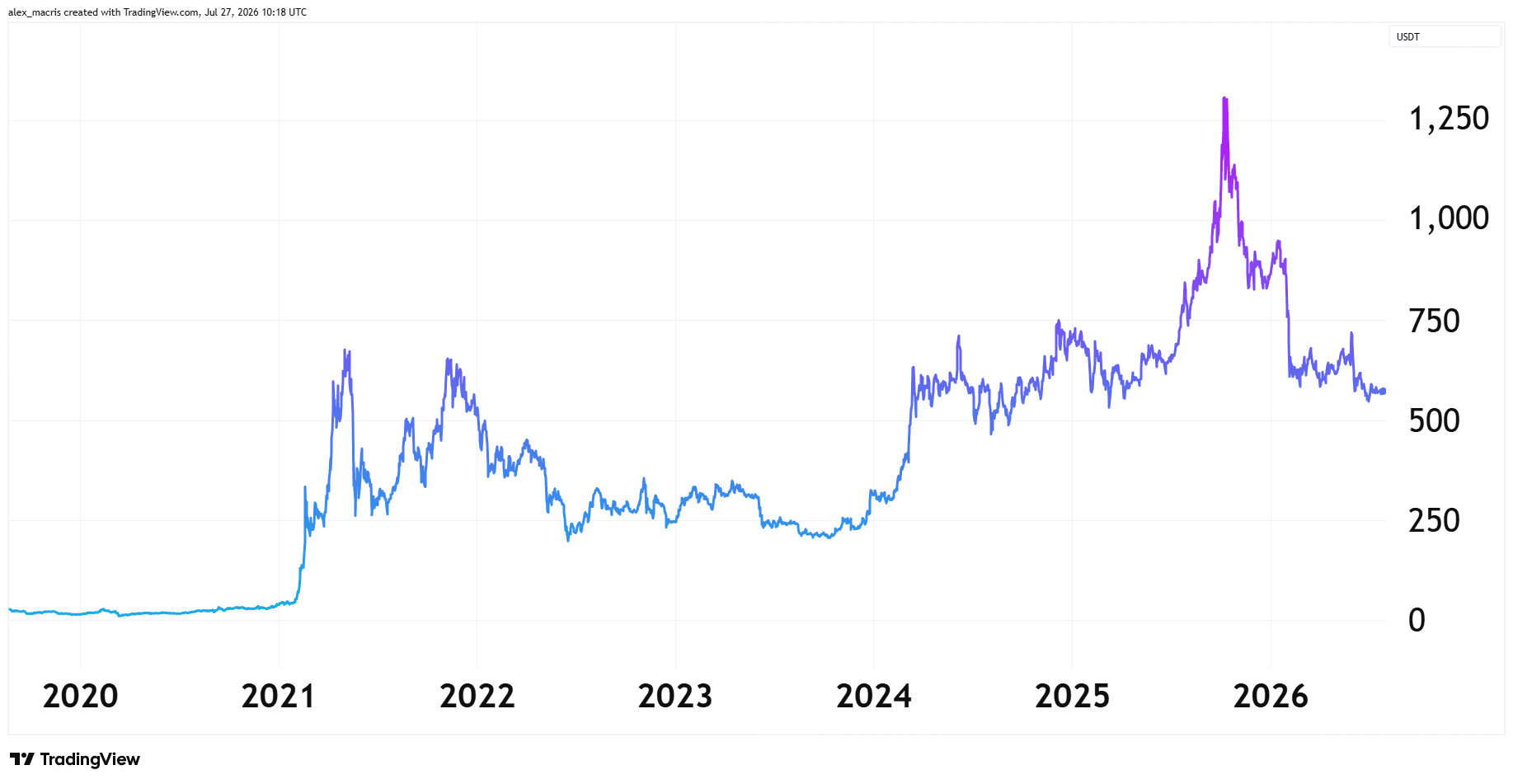
Like many cryptocurrencies, BNB has gone through several boom-and-bust cycles since its launch in 2017.
BNB skyrocketed in 2021, fuelled by Binance’s rapid growth, expansion into decentralised finance (DeFi), and a record number of token burns. It reached an all-time high of $706 in May 2021, having started the year at just $41. That surge was short-lived, however, as BNB dropped to around $210 by mid-2021 before recovering toward the end of the year.
The 2022 bear market brought renewed pressure, with BNB falling to a cycle low of about $183 in June 2022. Through late 2022 and much of 2023, BNB traded under pressure, dipping close to $200 again in October 2023.
Momentum shifted in late 2023. After October, BNB began recovering, with a decisive upswing starting in December. The rebound gained strength in 2024, supported by a combination of broader market recovery and BNB-specific catalysts. Key drivers included:
- The $4.3 billion US Department of Justice settlement early in 2024, which resolved regulatory uncertainty without criminal charges and restored investor confidence.
- Strong growth in the BNB Chain ecosystem, with improvements in scalability, a rise in Total Value Locked, and a jump in daily active users.
- Parallel rallies in Bitcoin and Ethereum.
BNB crossed back above $400 in February 2024 and traded in the $500–$750 range from March 2024 through mid-2025.
By July 2025, BNB broke out of its trading range and accelerated further, entering price discovery mode in August and setting a new all-time high of $1,355 in October 2025. This rally reflected both the crypto-wide bull market and ecosystem-specific momentum, the rise of real-world asset tokenisation, layer-2 decentralised exchanges, continued auto-burns, and trading volumes exceeding $4 billion.
The all-time high proved short-lived. A broad market correction through 2026 saw BNB shed more than 60% from its peak, with the token trading in a range between $530 and $600 at the time of writing.
On-chain metrics have remained relatively resilient through the correction, with average daily transactions growing from around 10 million in mid-2025 to approximately 15 million by Q1 2026, while median transaction fees remain below $0.00001, among the lowest across major smart contract networks.
Highs and lows in previous cycles
Year |
High |
Year |
Low |
Pullback % |
|
2018 |
26.5 |
2018 |
4.1 |
-84.53% |
|
2021 |
704.6 |
2022 |
183.4 |
-73.97% |
|
2025 |
1355 |
2026 |
537 |
-60.80% |
The current state of BNB and latest news
Over the past 12 months, Binance's primary challenge has been regulatory rather than competitive. The DOJ settlement installed independent compliance monitors running until at least 2027, and scrutiny has continued to mount: in April 2026, a US senator raised concerns over Iran-linked flows through the platform, while a July 2026 internal DOJ memo reportedly warned prosecutors to expect reduced cooperation from Binance, a claim the exchange firmly denied.
In Europe, Binance's Greek MiCA application was expected to be rejected, and with the June 30 transition deadline passing without approval, Binance suspended certain services and stopped accepting new clients in France, Poland, Italy, and Spain. Binance stated it was not leaving Europe and remained in active talks with EU regulators as of early July 2026.
Reuters reported in July 2026 that Binance was seeking more licences in Asia, expanding in the Philippines through a local partnership, and continuing to push for regulatory approvals outside Europe. Separately, Reuters reported that trading in Binance’s U.S. stocks and ETFs had exceeded $3 billion since launch.
VanEck launched the first US spot BNB ETF in May 2026, while BlackRock’s BUIDL had already integrated with BNB Chain in late 2025, adding institutional credibility to the ecosystem.
BNB price predictions 2026-2050
Source |
2026 |
2027 |
2028 |
2030 |
2040 |
2050 |
|
Coinpedia |
$200–$1,000 |
$1,200–$1,800 |
$1,600-$2,300 |
$2,500–$4,500 |
$13,200–$38,000 |
$22,000–$50,000 |
|
CryptoNews |
* |
$625–$737 |
$680-$932 |
$783–$1,382 |
* |
* |
|
DigitalCoinPrice |
$585–$745 |
$677–$879 |
$709-$1,084 |
$1,085–$1,397 |
$1,787-$1,931 |
$2,061-$2,155 |
|
CoinCodex |
$566–$894 |
$801–$1,907 |
$1,245-$2,020 |
$1,489–$1,949 |
$2,590–$2,909 |
$3,844–$4,147 |
|
InvestingHaven |
$590–$900 |
$750–$1,050 |
$900-$1,300 |
Up to $2,000 |
* |
* |
|
Standard Chartered |
$1,755 |
$2,225 |
$2,775 |
* |
* |
* |
* No forecast available for this year. Standard Chartered figures are year-end targets from Geoffrey Kendrick, global head of digital assets research.
Disclaimer on crypto price predictions
Most websites that predict cryptocurrency prices base their forecasts on historical price data, technical indicators, and market sentiment. These models are typically non-transparent, unverified, and not supported by formal backtesting, meaning their accuracy cannot be independently confirmed. Forecasts from such sources should therefore be treated as speculative opinions rather than reliable financial projections.
Site-specific notes:
- CoinCodex: Algorithmic forecasts using price history, technical indicators, and Bitcoin halving cycles; no accuracy data published. Link
- Investing Haven: Chart-pattern and timing-cycle analysis; subjective and not backtested. Link
- Coinpedia: Trend extrapolation with bullish assumptions; lacks verified performance data. Link
- CryptoNews: Combines technical and narrative factors; no formal validation. Link
- DigitalCoinPrice: Trend-based model using historical data; no evidence of backtesting. Link
BNB price prediction for 2026
Forecasts for 2026 reflect the sharp correction BNB has undergone since its October 2025 all-time high, with analysts now divided on whether the current price range represents a buying opportunity or the start of a more prolonged downturn.
DigitalCoinPrice and InvestingHaven project ranges of $585–$745 and $590–$900 respectively, broadly in line with current trading levels. CoinCodex sits in a similar range at $566–$894. Coinpedia offers the widest spread, from $200 on the downside if key support fails to $1,000 in a bull case, with a base case around $600. Standard Chartered's year-end target of $1,755 stands well above the consensus, reflecting confidence in BNB's deflationary mechanics and Binance's structural market position.
Overall, 2026 is seen as a transitional year, with BNB's trajectory depending on whether it can reclaim key support levels and whether Binance resolves its regulatory overhang in Europe and the US.
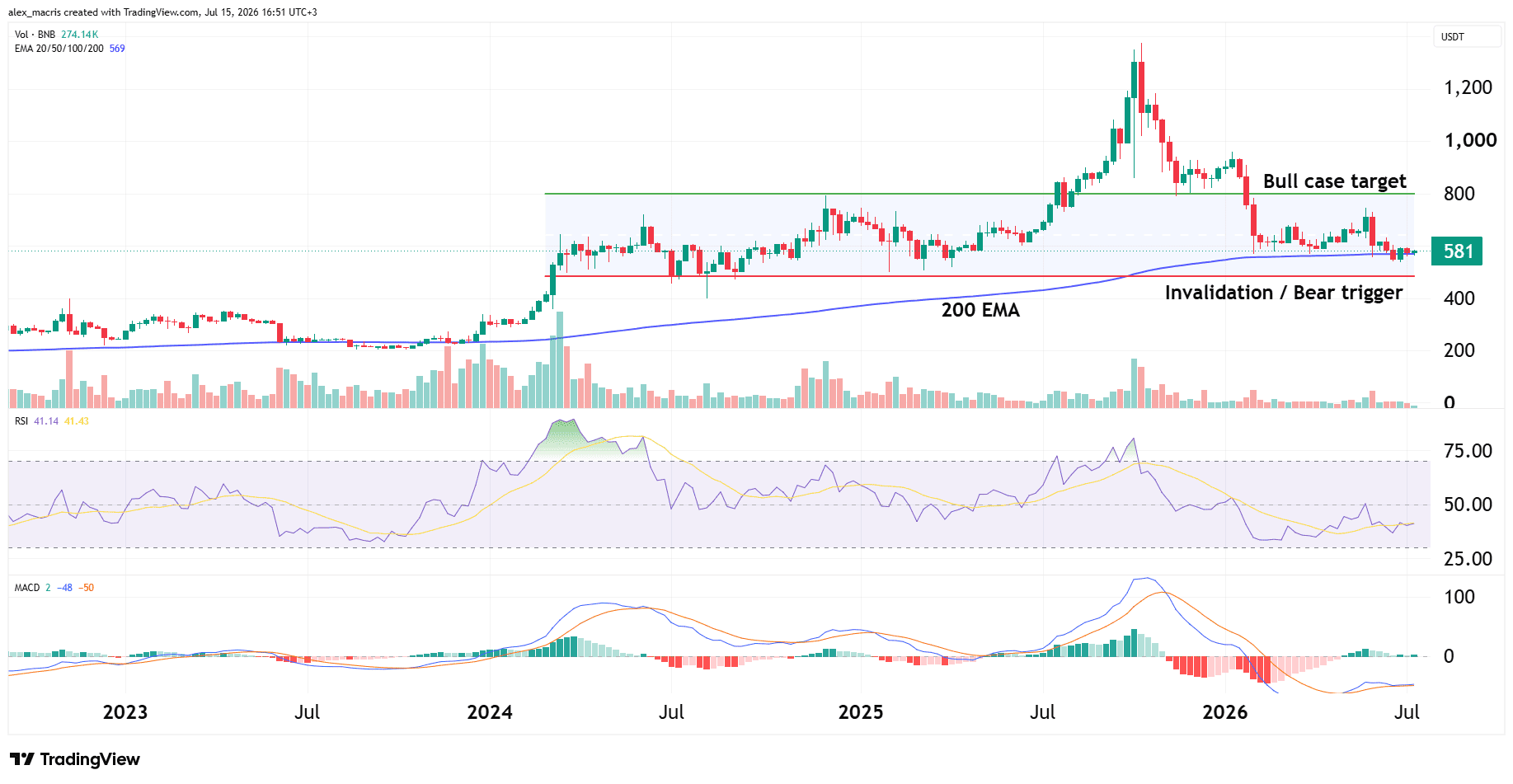
BNB/USD Technical Outlook and short-term prediction | July 2026 Axi Analyst
BNB is trading around $581, approximately 58% below its October 2025 all-time high of $1,355, and sitting directly on the 200 weekly EMA. The weekly RSI remains below the 50 midline, and the MACD histogram shows early signs of selling momentum fading. Neither signal confirms a reversal, but the current level represents a key test for the medium-term outlook.
For 2026, three scenarios seem plausible:
- Bull: 200 weekly EMA holds, price recovers toward $800 by year-end, contingent on broader market recovery and Binance resolving its regulatory overhang.
- Base: Range-bound consolidation between $580–$680, with the 200 EMA as floor and declining daily EMAs as overhead resistance.
- Bear: A weekly close below $530 opens a path toward $485, the base of the 2024 consolidation zone.
Invalidation level: $485 on a weekly closing basis.
This analysis is for informational purposes only and does not constitute financial advice. CFD trading involves risk and may not be suitable for all investors.
BNB price prediction for 2027
For 2027, most forecasts point to a recovery from current levels, though the range of opinion remains wide.
CryptoNews projects $625–$737, the most conservative view, treating 2027 as a period of gradual stabilisation. DigitalCoinPrice sits higher at $677–$879, while InvestingHaven projects $750–$1,050, noting that the size of any recovery will depend on Binance's regulatory positioning and its continued dominance in global crypto trading. CoinCodex is more bullish at $801–$1,907, and Coinpedia projects $1,200–$1,800, anticipating stronger institutional adoption and an expanded DeFi presence. Standard Chartered's year-end target of $2,225 is the highest for this year, underpinned by the bank's view of BNB's deflationary mechanics and Binance's structural market position.
Overall, analysts see a recovery through 2027 as plausible, contingent on BNB holding key support levels and Binance maintaining its exchange dominance.
BNB price prediction for 2028
2028 is the year where institutional and algorithmic forecasts diverge most sharply and where the cycle thesis matters most.
Most forecasts cluster between $700 and $2,300, with InvestingHaven, CryptoNews, and DigitalCoinPrice toward the lower end and CoinCodex and Coinpedia projecting highs above $2,000, reflecting expectations of continued ecosystem expansion and a potential crypto cycle peak. Standard Chartered's Geoffrey Kendrick stands apart with a year-end target of $2,775, citing BNB's deflationary mechanics and Binance's sustained dominance as the primary drivers, a gain of over 360% from current levels if realised.
The 2028 outlook is closely tied to the broader crypto market cycle. If a halving-driven bull run materialises, exchange tokens like BNB have historically outperformed during peak trading volume periods.
BNB price prediction for 2030
By 2030, forecasts diverge sharply, reflecting uncertainty over long-term adoption and regulatory developments.
CryptoNews, DigitalCoinPrice, and CoinCodex cluster between $783 and $1,949, suggesting steady but controlled growth. InvestingHaven caps its projection at $2,000, citing regulatory factors as the key constraint. Coinpedia stands out as the most bullish, projecting $2,500–$4,500, based on assumptions of large-scale DeFi integration and broader blockchain expansion.
Overall, analysts view 2030 as a potential inflection point, with BNB's trajectory highly dependent on global crypto adoption and Binance's sustained influence in the digital asset space.
BNB price forecasts for 2040
At a 15-year horizon, only three sources publish forecasts, and their conclusions are far apart.
DigitalCoinPrice projects $1,787–$1,931, reflecting modest incremental growth broadly in line with general cryptocurrency adoption trends. CoinCodex projects $2,590–$2,909, slightly more optimistic but still conservative relative to BNB's current all-time high. Coinpedia's range of $13,000–$38,000 assumes transformative global adoption of DeFi and Web3 infrastructure, with BNB retaining a dominant share of that ecosystem.
BNB price forecasts for 2050
DigitalCoinPrice projects $2,061–$2,155, reflecting a conservative view of steady but modest long-term appreciation. CoinCodex sits slightly higher at $3,844–$4,147. Coinpedia's bull case of $22,000–$50,000 assumes BNB becomes a foundational layer of global decentralised finance over the intervening decades.
As with all long-range forecasts, these figures should be treated as illustrative scenarios rather than price targets.
Conclusion
While long-term forecasts for BNB vary considerably, most analysts remain optimistic and expect prices to increase over the coming years and decades. The most cited drivers are BNB's growing importance in the DeFi space, its expanding utility beyond the Binance platform, as well as the ongoing developments within the BNB Chain ecosystem.
That said, BNB carries a concentration risk that most cryptocurrencies do not: its fortunes remain closely tied to Binance's regulatory standing, the ongoing US monitorship, the EU licensing setback under MiCA, and continued scrutiny from lawmakers.
FAQs
How high can BNB go?
There is no consensus upper limit. Bullish long-range forecasts suggest prices well above $2,000 by 2028 and into five figures by 2040, driven by DeFi adoption, deflationary tokenomics, and Binance's continued exchange dominance.
Can BNB reach $2,000?
Several analysts forecast BNB reaching or exceeding $2,000 before 2030, with Standard Chartered projecting $2,775 by end-2028. Whether this materialises depends on overall market conditions, Binance's regulatory standing, and the pace of BNB Chain adoption.
Is BNB a good investment?
Whether BNB is suitable depends entirely on your individual financial situation, risk tolerance, and investment objectives. BNB has demonstrated strong ecosystem growth and resilience across multiple cycles but carries the volatility typical of crypto assets alongside a specific concentration risk. Its value is closely tied to Binance's regulatory standing and continued exchange dominance.
How can I trade BNB?
BNB can be traded on Axi Australia as a Contract for Difference (CFD), allowing you to speculate on BNB's price without owning the underlying asset directly.
Read also
- Bitcoin price predictions
- Ethereum price predictions
- Solana price predictions
- XRP price predictions
Data is sourced from third party providers. This information is not to be construed as a recommendation; or an offer to buy or sell; or the solicitation of an offer to buy or sell any security, financial product, or instrument; or to participate in any trading strategy. It has been prepared without taking your objectives, financial situation and needs into account. Any references to past performance and forecasts are not reliable indicators of future results. Axi makes no representation and assumes no liability with regard to the accuracy and completeness of the content in this publication. Readers should seek their own advice.
Sources

Alex Macris
With a background spanning forex, stocks, and crypto, Alex has contributed financial and stock exchange reports to leading publications and news agencies. Beyond financial markets, he honed his skills by researching and editing international agreements and state reports and producing multimedia resources for diverse brands and organisations.
In addition to written content, Alex, who is fluent in English, French, and Greek, brings extensive experience and passion for audio. His portfolio showcases a versatile skill set encompassing podcast production, educational materials, and advertisements. A team player and lifelong learner, he maintains a balanced perspective on both the big picture and the finer details.
Find him on: LinkedIn