Key takeaways
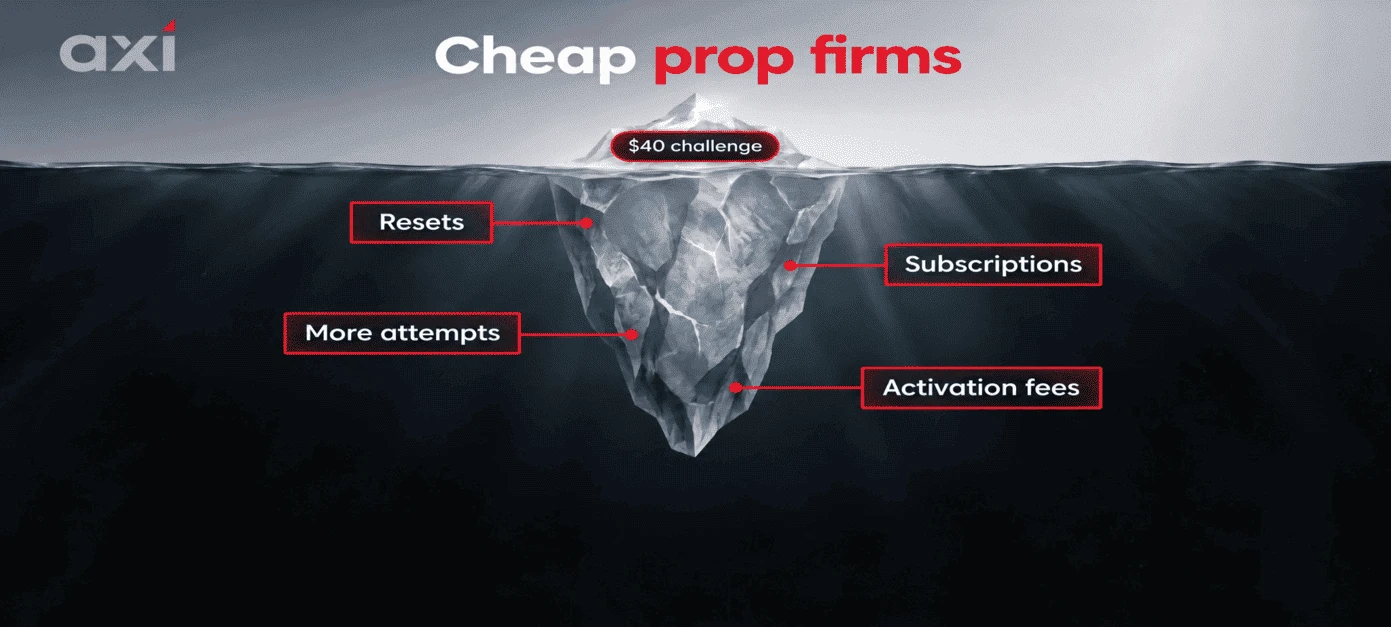
- Cheap prop firms sell evaluation challenges that often cost under $50 for a small account, but the fee buys one attempt, not a funded account.
- A $40 challenge is rarely a $40 cost to get funded. FPFX Tech data, reported by Finance Magnates covering 300,000+ accounts found that 14% of traders got funded, and the average account spent about $800 on challenges, usually across three attempts. The Funded Trader put its own pass rate at 5-10%. If you pass one attempt in seven, the cost of your first funded account is closer to seven fees than one.
- Prop firms that sell paid challenges collect the fee whether you pass or not. Axi Select has no registration or challenge fee. The $500 entry requirement is live trading capital under your own control.
- Most paid challenges run on simulated accounts, where no orders reach the market and at many firms the funded stage stays simulated too. Axi Select scores you on a live Axi account instead, so your orders are filled in the real market. The result reflects what you'd see trading for real, good or bad.
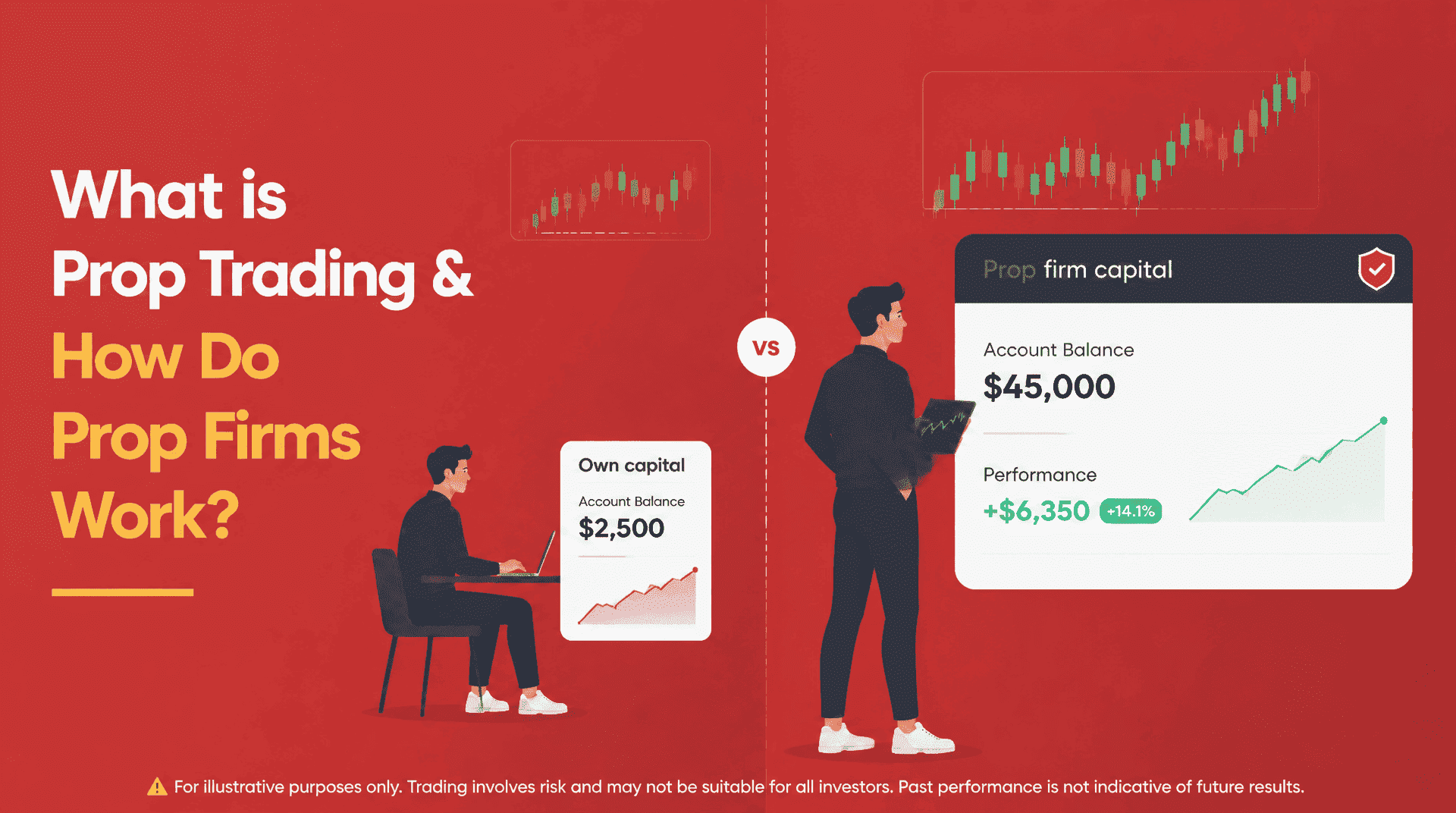
Cheap prop firms are proprietary trading firms that sell low-cost evaluation challenges, often under $50 for a small simulated account. Pass the rules and you get a funded account with a share of the profits. Breach them and the fee is gone.
On paper, it looks like the cheapest way to trade with more capital than you have. But is a $50 challenge really a $50 cost?
Most of the times, no. The majority pay that fee more than once and many pay it several times without ever seeing a payout.
And interest has grown fast. Searches for "cheap prop firms" went from almost nothing in 2021 to around 4,500 a month in English, and to approximately 15,000 a month once you include terms like "cheapest prop firm" and "cheap forex prop firms" (Axi Marketing data). Interest in prop firms overall shows the same rise on Google Trends.
In my 8 years in this industry, talking with traders, IBs and partners across Latin America, I keep seeing the same mistake. Many choose their program based on the evaluation fee. Very few work out the cost of actually getting to a payout.
At events in Mexico, Colombia and Argentina, the question I hear most is which prop firm is the cheapest. Almost nobody asks how much it really costs to get to a payout.
How much do cheap prop firm challenges cost?
Most cheap prop firm challenges cost between about $17 and $150 for a single attempt. The price depends on the size of the simulated account, how many evaluation phases there are and whether you pay once or every month.
Monthly plans look cheapest in month one. If you're still trying to pass in month four, they usually aren't.
I've grouped the main pricing models below, with what three attempts, or three months, would cost under each. Prices change all the time, so check the firm's own page before you pay for anything.
| Pricing model | Upfront price | 3-month cost | The catch | Ideal trader |
|---|---|---|---|---|
| Zero-fee broker-backed (e.g. Axi Select) | $0 | $0 | Requires building an internal performance score on live accounts using your own capital deposit rather than passing a standard simulated demo challenge. | Traders seeking regulated environments, live market execution, and zero evaluation fees. |
| The micro-challenge (e.g. Funding Pips, Maven Trading) | ~$17 - $39 | ~$17 - $39 | One-time fee, but often comes with highly restrictive consistency rules and strict daily drawdown limits on tiny $5K balances. | Beginners. |
| The one-time fee futures (Phidias, Tradeify) | ~$69 - $240 | $69 - $240 if you pass on the first attempt. Each reset adds another fee. | No monthly billing, but relies heavily on end-of-day (EOD) trailing drawdowns or static ceilings that easily catch aggressive traders. | Futures traders who want to avoid monthly subscriptions. |
| The standard subscription (Topstep, Alpha Futures) | $49 - $199 / month | $147 - $597 | Reliable payout track records, but recurring monthly fees stack up quickly if you hit an extended drawdown or flat market streak. | Consistent traders confident in passing evaluations within 30-60 days. |
| The expensive subscription and activation fee (Take Profit Trader, FunderPro) | ~$90 - $177 / month | $270 - $670+ | Requires keeping up with a monthly testing fee plus a hefty activation fee (often $90 to $150+) once you actually pass the evaluation. | Aggressive scale-up traders who rely heavily on promotional discounts. |
| The one-step model (Goat Funded, The5ers) | ~$60 - $140 | ~$60 - $140 | One-time entry with no multi-week time rules, but uses increased profit targets (often 10%) and sensitive real-time trailing risk calculation. | High-win-rate traders looking for the fastest route to a funded account. |
| The instant funding, no evaluation model (City Traders Imperium, FundedNext) | ~$69 - $449+ | ~$207 - $1,347+ | Bypasses the evaluation test, but features premium entry fees, lower starting profit splits (50-70%) and tight maximum loss rules. | Experienced traders. |
Prices shown are indicative and change often, as many prop firms offer discounts and promotions.
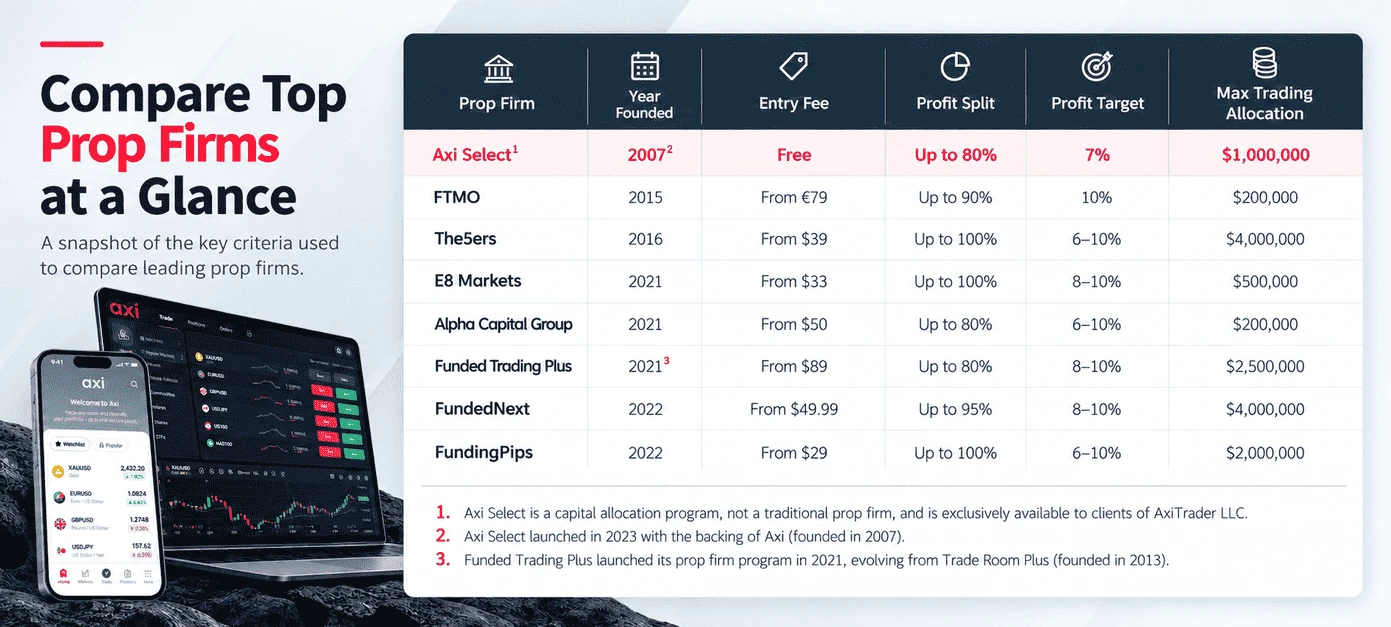
If you're comparing firms on more than entry price, our guide to the best prop trading firms covers funding limits, profit splits, trading conditions and programme structures.
The maths behind a cheap prop firm challenge
Most budget prop firms use simulated (demo) accounts with strict daily drawdowns and profit targets. FPFX Tech data reported by Finance Magnates covering more than 300,000 accounts across 10 prop firms, showed that about 14% of traders passed. Most buyers therefore pay again.
In a smaller poll conducted by PipFarm, 459 respondents reported spending an average of $4,270 on challenges, and most had used more than one firm.
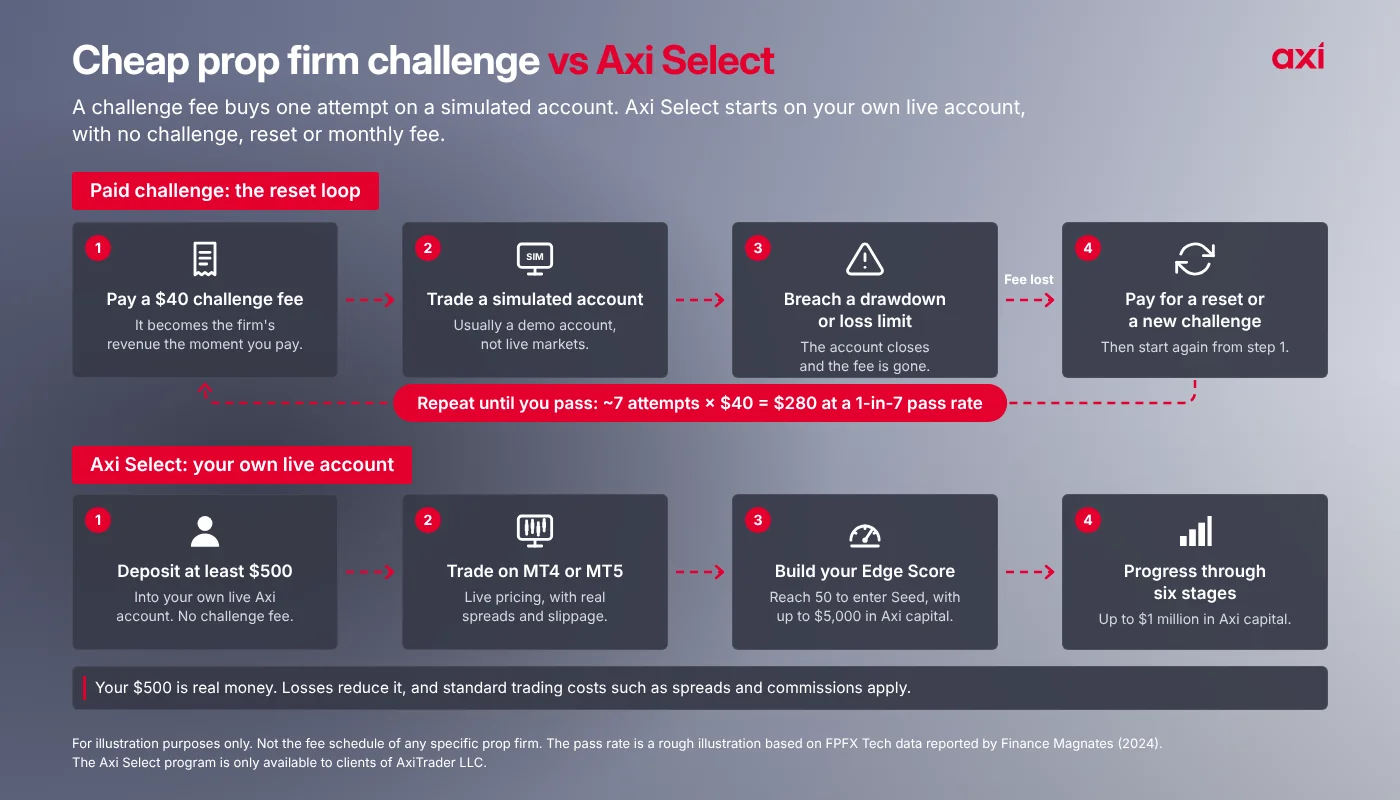
Here's what that looks like at $40 a time:
- You buy a $40 evaluation.
- You breach a drawdown or loss limit.
- You pay for a reset or a new challenge.
- You repeat until you pass or stop.
If you pass one attempt in seven, you've paid about seven fees by the time you do. And none of that money is trading capital. You've paid for access to a simulator seven times.
Total cost = (challenge fee × attempts) + resets + subscriptions + activation fees
In my experience, the attempts are the part almost everyone underestimates.
| Attempts until passing | Challenge fees | Reset fees | Subscriptions | Activation | Total cost |
|---|---|---|---|---|---|
| 1 | $40 | $0 | $49 | $150 | $239 |
| 2 | $80 | $30 | $98 | $150 | $358 |
| 3 | $120 | $60 | $147 | $150 | $477 |
| 5 | $200 | $120 | $245 | $150 | $715 |
| 7 | $280 | $180 | $343 | $150 | $953 |
| 10 | $400 | $270 | $490 | $150 | $1,310 |
Illustrative scenario, not the actual fee schedule of a particular prop firm. Actual reset, subscription and activation fees vary by provider.
What happens when you fail a challenge?
When you fail a prop firm challenge, you usually lose the fee and the account is closed. To keep going, you buy a reset or a new challenge.
- The challenge fee is normally gone. Some firms refund it, but typically only after you pass or receive your first payout.
- You pay for a reset or a new challenge to try again.
- Monthly subscriptions keep billing until you cancel.
- Passing doesn't always mean payouts straight away. Activation fees, identity checks and minimum trading days may apply first.
Axi Select has no challenge to buy, no reset fee and no evaluation subscription. A losing trade comes out of your own balance, exactly as it would on any live account, and what's left stays in your account.
Most paid challenges, by contrast, start on simulated accounts. As cTrader developer Spotware explains, firms usually place traders on demo accounts during the evaluation instead of committing live funds. A simulated execution doesn't touch real liquidity, so spreads and slippage in fast markets may not behave the way they would on a live account. That matters when you're deciding whether a strategy is ready.
The reset loop vs. the live account path
New to funded trading? Our guide to what a funded trading account is and how it works explains evaluations, profit splits and what happens after you pass.
Are cheap prop firms reliable?
Some are. But a low entry price tells you nothing about whether a firm will still be paying out next year.
According to Finance Magnates, between 80 and 100 prop firms shut down in 2024, with closures continuing over the next years, as outlined in our prop firm comparison. Before paying for a challenge, these are the questions I'd ask:
- Is the company transparent about its legal entity?
- Does it clearly explain whether accounts are simulated or live?
- Are payout conditions publicly available?
- Does it publish drawdown and risk-management rules?
- Are there restrictions that can invalidate otherwise profitable trading?
- Is there a clear dispute-resolution process?
- Does the company have an established broker relationship or infrastructure?
One more point. If you keep breaching daily drawdown limits, another challenge won't change the result. I've watched traders buy reset after reset, hoping the next one would be different. Work on your position sizing and risk management first, then decide whether a paid evaluation makes sense for you.
Before choosing a challenge, it's worth understanding how proprietary trading works, including how prop firms evaluate traders, allocate capital and share profits.
Is there a prop firm with no challenge fee?
Yes. Axi Select is one example, and it works differently from a prop firm challenge. It's a capital allocation programme run by Axi, a broker operating since 2007, and it charges no registration, challenge or monthly fee.
Instead of buying an evaluation, you open a live Axi account, fund it and trade on MT4 or MT5 as you normally would. Every trade feeds your Edge Score, which measures skill, risk management and consistency, adjusted for trading experience.
Reach an Edge Score of 50 with at least $500 in your account and you enter the Seed stage, where Axi allocates up to $5,000 of its own capital to a separate allocation account. Six stages take you up to $1 million in Axi capital.
Profit share is 0% at Seed, then rises from 40% at Incubation to 80% at Pro M. Payouts are made on the 1st of every month.
Affordable prop firms vs. Axi Select
| Parameter | Traditional "Cheap" Prop Firm | Axi Select |
|---|---|---|
| Upfront Fee | $35 - $150 per attempt (usually non-refundable) | $0 (No challenge or registration fees) |
| What happens to your money if you breach a rule | The fee is lost and you pay again to retry | Your remaining balance stays in your own account |
| Account Type | Demo / Simulation | Live broker account |
| Time Restrictions | High (Strict deadlines or target pressure) | No maximum time limit. Minimum stage durations apply (e.g. 30 days at Seed) |
| Profit Split | 70% - 90% | Up to 80% (Scales progressively) |
This comparison is for information only. Trading conditions vary by provider, account type and region. Check current terms on each provider's official website before you trade.
How to evaluate a prop firm's true cost
So the question isn't which prop firm is cheapest. The right question is: what will it cost me to get funded, and what will I still own if I don't?
Four checks will tell you most of what you need.
- Price the attempts, not the ticket. Multiply the fee by a realistic number of attempts. Use the industry pass rates above or, better, your own record under similar rules.
- Ask where your money goes. A challenge fee becomes the firm's revenue the moment you pay. A deposit with a broker stays in your account as trading capital: at risk from your trades, but still yours.
- Find out what's simulated. Check whether the evaluation and the funded stage run on simulated or live accounts, and how payouts are funded.
- Read the rules that close accounts. Daily drawdowns, consistency rules, news restrictions, minimum days, activation fees and payout conditions affect how many attempts you'll need.
Choosing a prop firm on total cost
A cheap prop firm challenge isn't good or bad on its own. What matters is how many times you pay, and what you're left holding when an attempt ends.
A $40 challenge you pass first time is good value. The same challenge bought seven times costs $280, and none of it is yours.
The partners in LATAM who build a lasting business with their communities are the ones who talk about total cost, not ticket price.
And if you'd rather build your record on live markets, with your own money in your own account, Axi Select gives you that route without a challenge fee. Whichever way you go, decide with the full cost in front of you.
The Axi Select program is only available to clients of AxiTrader LLC.
This information is not to be construed as a recommendation; or an offer to buy or sell; or the solicitation of an offer to buy or sell any security, financial product, or instrument; or to participate in any trading strategy. It has been prepared without taking your objectives, financial situation, or needs into account. Any references to past performance and forecasts are not reliable indicators of future results. Axi makes no representation and assumes no liability regarding the accuracy and completeness of the content in this publication. Readers should seek their own advice.

Milton López
Milton López leads Axi’s commercial development across LATAM. He joined Axi four years ago as Head of Latin America, building the company’s regional presence from the ground up. He oversees partnerships with introducing brokers and affiliates, ambassador and influencer programmes, market expansion, marketing strategy, and team development.
With more than 10 years of experience at the intersection of business development, strategic partnerships, and brand positioning in emerging markets, Milton has closed deals across more than 12 countries and represented the industry at regional and international conferences, including in Mexico, Colombia, and Brazil.
He believes the financial industry in LATAM is at a turning point. Greater access to markets, evolving regulation, and the emergence of new business models are reshaping the ecosystem, and those who understand that transformation first will gain a significant advantage.