Solana (SOL) price predictions for 2026 range from $74 at the cautious end to $350 at the bullish end, while 2030 forecasts span $9.81 to $3,211 across the analysts tracked below.
- 2026: $74 (DigitalCoinPrice floor) to $350 (CryptoNewsZ best case). Standard Chartered sits at $250.
- 2027: $79 to $600, the widest spread of any near-term year covered.
- 2030: $9.81 (VanEck bear) to $3,211 (VanEck bull), with Standard Chartered at $2,000.
- 2040 and 2050: $230 to $4,800 for 2040; $308 to $10,000 for 2050.
Past performance is not indicative of future results. Not intended as investment advice.
Table of Contents
- 1. What is Solana?
- 2. What is Solana used for?
- 3. Solana highlights
- 4. Solana price today
- 5. What affects the price of SOL?
- 6. Historical price performance
- 7. Solana price predictions 2026–2050
- 8. Conclusion
- 9. FAQs
- 10. References
What is Solana?
Solana is a high-performance blockchain platform launched in March 2020, built for smart contracts, DeFi, NFTs, and decentralised applications. It was created by Anatoly Yakovenko, who continues to drive its development.
Solana’s architecture addresses Ethereum's primary limitations: slow transaction processing and prohibitive fees. By lowering costs and increasing speed to attract developers, Solana competes in the "Ethereum killer" category alongside networks like Cardano (ADA), Polkadot (DOT), Avalanche (AVAX), and Tezos (XTZ).
Solana reaches consensus using Proof of Stake, where validators stake SOL to propose and confirm blocks. Two additional components explain its throughput. Proof of History (PoH) acts as a verifiable clock, timestamping and ordering transactions before they are confirmed, which removes much of the coordination overhead other chains carry. Sealevel, its runtime, then executes non-conflicting transactions in parallel rather than one at a time.
Its architecture also supports horizontal scaling, meaning more hardware can be added without compromising performance as demand grows. Another key attribute is low latency; high-speed applications like trading benefit greatly from Solana's rapid confirmation times.
Validators who stake SOL are rewarded for their contributions to network integrity. Some argue that Solana is less decentralised than other blockchains like Ethereum because there are fewer validator nodes and running a validator requires powerful hardware, making it potentially less accessible.
A history of outages caused by software bugs and malicious attacks has raised reliability concerns, highlighting Solana's need for ongoing architectural upgrades. While the network boasts lower fees than congested alternatives like Ethereum, scalability remains a test; past surges in meme coin volume and algorithmic trading heavily strained its capacity.
SOL has recovered from previous drawdowns and technical disruptions, though past recoveries say nothing about future ones, and the token remains among the more volatile assets in the top ten by market capitalisation.
What is Solana used for?
Solana is used for DeFi, NFTs, and stablecoins. Its speed and low fees make it attractive for high-frequency trading applications, meme coin activity, and payment settlement.
Key DeFi protocols on Solana
- Jupiter Exchange: the leading DEX aggregator on Solana by volume, routing trades across multiple liquidity sources for best execution.
- Orca: Solana's dominant concentrated-liquidity DEX; significant TVL and widely used for liquidity provision.
- Raydium: major automated market maker; popular for token launches and swaps.
- Kamino Finance: a lending and liquidity protocol with over $1.37 billion in Total Value Locked (TVL) as at mid-2026, making it one of the largest DeFi applications on Solana.
- Jito: liquid-staking and MEV infrastructure; its JitoSOL token has attracted substantial capital and introduced professional-grade MEV management to the network.
- Sanctum: liquidity infrastructure for Solana's liquid-staking ecosystem, enabling custom staking tokens and improving capital efficiency.
Wallets and staking
Phantom Wallet, which originally launched exclusively on Solana before expanding to other chains, has played a central role in the network's user growth. Its monthly active users rose from roughly 40,000 in 2021 to approximately 10 million in 2024. Its streamlined interface for token swaps, staking, NFTs, and asset management lowered the entry barrier for retail users.
Solana staking allows SOL holders to earn network rewards while contributing to ecosystem security, either directly through validators or via liquid-staking protocols like Jito and Sanctum. This feature is accessible directly through Phantom and other major wallets. As the network is used increasingly for settlements, the stablecoin supply on Solana has grown to over $15 billion.
Solana highlights
The FTX collapse and recovery
As some of Solana's largest backers, FTX and its sister firm Alameda were heavily exposed to the ecosystem. When FTX collapsed in November 2022, SOL fell nearly 70% in four days and bottomed out near $8 by year-end, a 97% decline from its 2021 peak.
What followed was one of the most dramatic recoveries in crypto history: after climbing steadily from October 2023 and reclaiming the $200 level in early 2024, SOL set a new all-time high of $295 on 19 January 2025.
Firedancer
Jump Crypto's Firedancer is an important infrastructure upgrade built to scale Solana's throughput and reliability. Launched on mainnet in December 2025, the validator client already powers more than 20% of active validators. Full network migration is targeted for the second half of 2026.
Spot Solana ETFs
Following the approval of spot Bitcoin and Ethereum ETFs in the United States, asset managers filed for spot SOL ETF products. By Q1 2026, approximately eight firms were sponsoring US spot Solana ETFs across major exchanges including NYSE, NASDAQ, and CBOE, with the Bitwise BSOL product emerging as the largest holder. As at early May 2026, combined net assets stood at approximately $938 million, with cumulative net inflows since listing reaching $1 billion.
Regulatory clarity
On 17 March 2026, the SEC and CFTC jointly classified SOL, alongside 15 other major cryptocurrencies, as a digital commodity rather than a security, ending more than a decade of regulatory ambiguity and removing a significant barrier to institutional participation. Staking is explicitly excluded from securities regulations under the ruling. The CLARITY Act, which would codify this classification into federal statute, passed the House in July 2025 and is progressing through the Senate.
Beyond the US, Israel's Capital Market, Insurance and Savings Authority approved BILS, a shekel-pegged stablecoin by Bits of Gold, in April 2026 following a two-year pilot on Solana, while Western Union has announced plans to launch a USD-backed stablecoin on the network.
Solana treasury companies
Several public companies are adopting a MicroStrategy-style model by adding SOL to their balance sheets as a primary reserve asset. Most stake their positions, capturing network rewards alongside any market movement.
For a current list of corporate SOL holders, see CoinGecko's Solana Treasury tracker.
Drift Protocol hack
On 1 April 2026, Drift Protocol, Solana's largest perpetuals exchange, was exploited for approximately $295 million in a North Korea-linked attack, the second-largest security incident in Solana's history.
Solana price today
SOL/USD is one of the most actively traded cryptocurrency pairs in the market, quoted 24 hours a day, seven days a week. Crypto markets do not close at the weekend, so SOL can gap sharply against Friday's levels when weekend liquidity thins out.
Intraday moves in SOL are driven largely by Bitcoin correlation, ETF flow data, network status, and scheduled token unlocks. Spreads typically widen during low-liquidity hours and around major macro releases.
For the live price, chart, spread, and swap conditions, see the Solana (SOL/USD) trading page.
What affects the price of SOL?
Tokenomics
Solana consistently ranks within the top ten cryptocurrencies by market capitalisation. Unlike Bitcoin (BTC), SOL has no hard supply cap, but it operates on a disinflationary emission schedule, where the rate of new token issuance decreases over time. SOL is distributed to founders, early backers, and validators who secure the network. Token unlock events, staking demand, and burn activity all influence the effective market supply.
Regulation
SOL's price is closely linked to the regulatory environment for DeFi and crypto more broadly. Favourable regulation, such as ETF approvals and commodity classification, has historically been a positive catalyst. Hostile or unclear regulation creates uncertainty that can suppress demand and price.
Market sentiment
Positive developments around Solana's technology, partnerships, or ecosystem growth tend to drive price appreciation. Network outages, hacks, and broader crypto selloffs have the opposite effect. The FTX collapse is the clearest example of sentiment overwhelming fundamentals in the short term.
Adoption and development
Developer activity, DeFi TVL, user growth, and transaction volumes remain leading indicators of network health. Major infrastructure milestones like the Firedancer rollout can shift market sentiment and attract institutional interest. The introduction of ETF products has also opened a channel of institutional demand that did not exist in earlier market cycles.
Competition
Solana competes with Ethereum and other smart contract platforms. Its advantage lies in throughput and cost, but outages and centralisation concerns have historically allowed competitors to make ground during periods of instability.
Liquidity and trading volume
High liquidity typically indicates robust market activity and can contribute to price stability. Low liquidity can amplify both upside and downside moves, which is relevant for traders sizing positions.
Historical price performance
Solana has gone through two complete boom-bust cycles since launch, with a new all-time high set in January 2025. Each cycle has been marked by sharp drawdowns and strong recoveries.
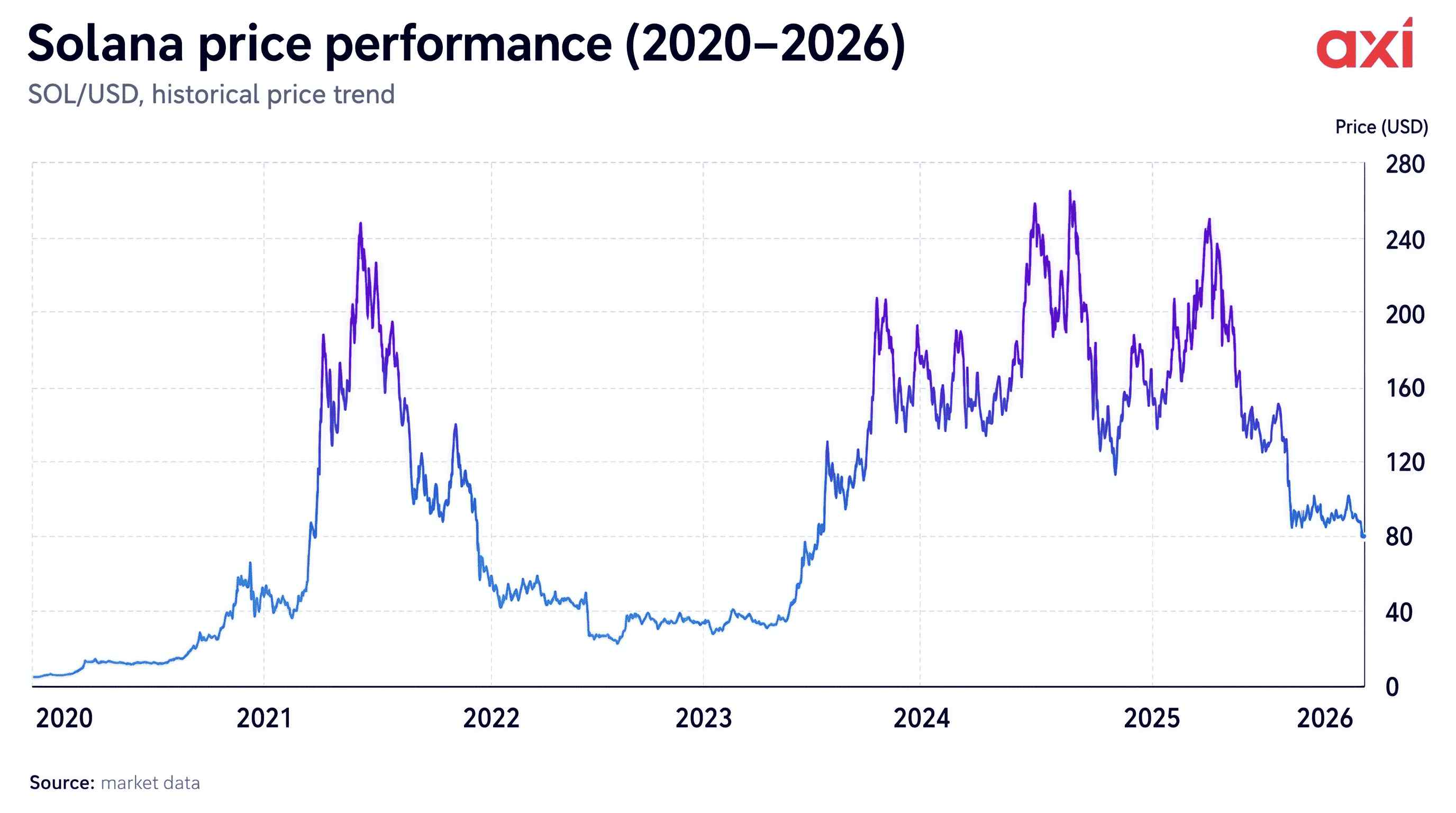
Past performance is not indicative of future results.
Lowest and highest SOL prices yearly since 2020
| Year | Lowest price (USD) | Highest price (USD) | Average price* (USD) |
|---|---|---|---|
| 2020 | 0.50 | 4.94 | 1.77 |
| 2021 | 1.50 | 260 | 80 |
| 2022 | 8 | 179 | 58 |
| 2023 | 9 | 125 | 29 |
| 2024 | 79 | 264 | 155 |
| 2025 | 67 | 295 | 170 |
*Average prices calculated from the sum of all daily closing prices divided by the number of days in the year. Where appropriate, figures have been rounded to the nearest whole number. Past performance is not indicative of future results.
Summary of SOL historical price performance
- Launch and early growth (2020): Solana launched in March 2020 with its price trading below $1 for much of the year, rising gradually as the project gained attention and development progressed.
- First bull run (2021): SOL crossed $10 for the first time in February 2021 amid growing interest in DeFi and blockchain scalability, reaching above $50 by May before a brief correction linked to Bitcoin's decline and regulatory concerns in China pulled it back below $25. Recovery was quick and SOL rocketed from August onwards, peaking near $260 in November before consolidating in the $100–$150 range by early 2022.
- Descent and decline (2022): A sharp decline from the start of the year settled into a $30–$40 range by mid-2022, before the FTX collapse in November sent SOL as low as $8 by year-end.
- Recovery (2023): SOL crawled back from its lows through the first half of the year, ranging between $20 and $25 before a strong October rally broke $100 by December and carried through to early 2024, where it broke $200.
- Second bull run (2024): Pump.fun became one of the most-used decentralised applications on any blockchain, driving substantial retail volume through Solana. DEX volume surpassed Ethereum's for ten consecutive months. Trump's election victory in November accelerated a rally that took SOL from $83 at the start of the year to close near $189.
- All-time high and correction (2025): SOL reached its all-time high of $295 in January, driven by sentiment around Trump's inauguration. The rally proved short-lived; trade war concerns, fading meme coin activity, declining ETF inflows, and macro pressure from the Bank of Japan's rate rise pushed SOL back to $95 by April. A recovery to $254 by September gave way to another decline, taking SOL to a year low of $67 and leaving it in the low $70s through to mid-2026.
- Recent developments (2026): Cross-chain protocol Symbiosis introduced full Solana support in April 2026. The integration enables single-transaction, any-to-any token swaps with on-chain routing powered by Raydium, allowing users to migrate assets from external source chains directly into native Solana tokens. In a more unconventional signal of the network's cultural reach, Alfreton Town FC, a club in the National League North, the sixth tier of English football, renamed its home ground Solana Stadium following a partnership with AlphaFC.
Solana price predictions 2026–2050
| Source / Year | 2025 | 2026 | 2027 | 2030 | 2040 | 2050 |
|---|---|---|---|---|---|---|
| Coinpedia | $209–$750 | $75–$200 | $180–$600 | $880–$1,400 | $320–$4,800 | $5,500–$10,000 |
| DigitalCoinPrice | $384–$459 | $74–$96 | $79–$124 | $111–$183 | $230–$251 | $308–$364 |
| Cryptonews (cryptonews.com) | * | * | $83–$91 | $93–$125 | * | * |
| CryptoNewsZ (cryptonewsz.com) | * | $100–$350 | $150–$500 | $550–$1,000 | * | * |
| Standard Chartered | $275 | $250 | $400 | $2,000 | * | * |
| VanEck | $520 | * | * | $9.81–$3,211 (base $335) | * | * |
*Price predictions are not provided from this source for this year. Where no high-low range is provided, the highest available figure has been used, except where otherwise stated. Past performance is not indicative of future results. Not intended as investment advice.
How 2025 predictions played out
Institutional forecasts for 2025 largely missed the actual shape of the market. VanEck's base case of $520 and Standard Chartered's year-end target of $275 both went unmet. Driven by post-election momentum, SOL reached its all-time high of $295 in January 2025 before pulling back sharply and spending much of the year well below that level. Coinpedia's range of $209 to $750 and DigitalCoinPrice's $384 to $459 both assumed a sustained bull run that failed to develop: SOL touched the lower bound of Coinpedia's range only briefly, and never reached DigitalCoinPrice's floor at all.
Solana (SOL) price prediction 2026
Analyst forecasts for 2026 span $74 to $350 and reflect clear uncertainty around the pace of institutional adoption and broader market conditions.
Standard Chartered downgraded its initial $310 projection to a year-end target of $250. It notes that while transitioning from speculative meme coins to stablecoin utility is a long-term positive, it could mute immediate price momentum.
Coinpedia projects a wide range of $75 to $200 based on ecosystem traction. Taking a more optimistic view, CryptoNewsZ expects a baseline range of $130 to $250, with a best-case target of $350 fuelled by successful network upgrades, and a bearish floor between $100 and $120. DigitalCoinPrice is the most conservative of the group at $74 to $96.
Across the board, consensus holds that Solana's trajectory in 2026 relies on three pillars: the full Firedancer implementation, consistent ETF capital inflows, and a sustained broader market recovery.
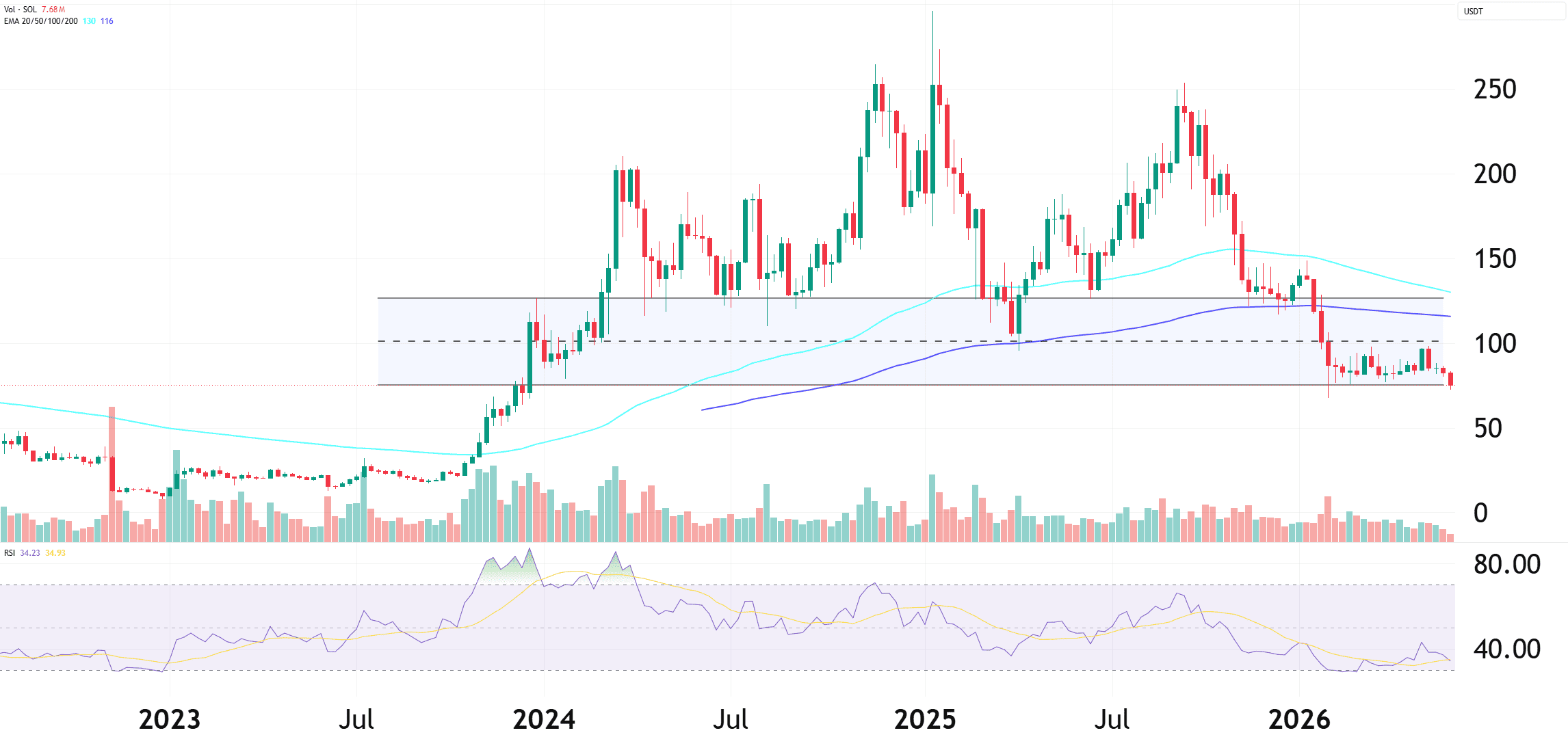
Past performance is not indicative of future results. For illustration purposes only.
SOL/USD technical outlook: Axi analyst view
As at 22 June 2026, SOL was trading around $75, deep in a correction that had erased approximately 75% of its value since the January 2025 all-time high of $295. The daily RSI signalled deeply oversold conditions and pointed to a near-term bounce as the most probable outcome, with the immediate target capped between $85 and $95. The broader macro trend stayed firmly bearish. Price continued to trade below both the 100-week and 200-week EMAs, which were sloping downward, and the weekly RSI had yet to touch the sub-30 levels that marked the bottom of the 2022 market cycle.
| Scenario | Level | Condition |
|---|---|---|
| Bull | $120 or above by year-end | Broader market recovery, with SOL holding above $70–$72 on a weekly close |
| Base | $85–$120 through H2 2026 | Range-bound as the market digests the correction |
| Bear | $60–$65 | A break below $70–$72 |
| Invalidation level | $70 on a weekly close | A break below this level negates both the base and bull cases |
This analysis is for informational purposes only and does not constitute financial advice. For illustration purposes only. Past performance is not indicative of future results. Not intended as investment advice. CFD trading involves risk and may not be suitable for all investors.
Solana (SOL) price prediction 2027
Forecasts for 2027 span $79 to $600, the widest near-term spread in the table.
Cryptonews anchors its outlook to on-chain fundamentals, projecting a modest range of $83 to $91. Its thesis centres on three variables: network performance, decentralised application demand, and Bitcoin correlation. It flags congestion risk during market peaks as a potential catalyst for users migrating to Ethereum Layer 2 networks, cautioning that any target represents a hypothetical scenario rather than a firm forecast.
Standard Chartered sits at the opposite end of the institutional spectrum, forecasting a surge to $400 as micropayment adoption scales and new applications leverage Solana's low-cost infrastructure.
Coinpedia's range of $180 to $600 is the widest of the group, reflecting the difficulty of projecting an asset sitting in the middle of a potential market cycle. DigitalCoinPrice again marks the floor at $79 to $124, and CryptoNewsZ sits between the two at $150 to $500.
That spread underlines how dependent 2027 valuations are on the success of the Firedancer rollout and sustained institutional capital inflows.
Solana (SOL) price prediction 2030
By 2030 the range of analyst opinion widens to $9.81 at the low end and $3,211 at the high end, reflecting how differently forecasters weight the pace of DeFi adoption, institutional participation, and macro cycle dynamics.
Standard Chartered's Geoffrey Kendrick places his target at $2,000, built on the view that Solana is positioned to dominate the micropayments and stablecoin settlement space, where its network already processes stablecoin turnover at a multiple of Ethereum's rate.
VanEck's scenario model spans $9.81 in a bear case, $335 at the base, and $3,211 in a bull case, the latter contingent on Solana hosting the first blockchain application with 100 million or more users. The model was built before Firedancer, the spot ETF market, and the SEC/CFTC commodity classification, all of which arguably strengthen its adoption assumptions.
Coinpedia projects $880 to $1,400 and CryptoNewsZ $550 to $1,000, both on the basis of continued Web3 infrastructure buildout. Cryptonews takes the opposite view with a technically driven $93 to $125, treating 2030 as a post-halving consolidation year, while DigitalCoinPrice sits at $111 to $183.
Most sources expect the price to be higher in 2030 than in 2026, but the variance is a reminder that long-range crypto forecasts carry significant uncertainty and depend heavily on real-world adoption outcomes.
Solana (SOL) price prediction 2040
For 2040, projections span $230 to $4,800. DigitalCoinPrice forecasts a conservative $230 to $251 based on gradual market growth. Coinpedia offers a much broader range of $320 to $4,800, tying its maximum bull case to shifts in global blockchain adoption, infrastructure upgrades, and macro conditions over the intervening decades.
Solana (SOL) price prediction 2050
Projections for 2050 span $308 to $10,000 and serve as macro thought experiments rather than actionable forecasts. On the conservative end, DigitalCoinPrice expects $308 to $364, reflecting steady long-term growth. On the bullish end, Coinpedia’s target of $5,500 to $10,000 assumes Solana becomes a foundational layer for global finance and Web3 over the next quarter-century.
Conclusion
Long-range forecasts for Solana skew positive, underpinned by a maturing DeFi ecosystem, institutional access via ETF products, infrastructure improvements through Firedancer, and growing regulatory clarity. The near-term picture is more divided: Standard Chartered and CryptoNewsZ see recovery into the $250 to $350 area during 2026, while DigitalCoinPrice and Cryptonews expect SOL to stay below $100 into 2027.
Solana-specific risks, including network reliability, smart contract vulnerabilities, and competitive pressure from Ethereum and other platforms, remain live considerations. As with all speculative assets, analyst forecasts should be treated as informed estimates, not guarantees.
Solana price prediction FAQs
What is the Solana price prediction for 2026?
Forecasts for 2026 range from $74 to $350. DigitalCoinPrice is the most conservative at $74 to $96, Coinpedia projects $75 to $200, Standard Chartered targets $250, and CryptoNewsZ sets a best case of $350.
What is the Solana price prediction for 2030?
Forecasts for 2030 range from $9.81 to $3,211. VanEck's scenario model covers both extremes with a base case of $335, Standard Chartered forecasts $2,000, and Coinpedia projects $880 to $1,400. Cryptonews is the most conservative at $93 to $125.
How high can Solana go?
There is no consensus upper limit. The most bullish long-range forecasts in the table above reach $3,211 by 2030, $4,800 by 2040, and $10,000 by 2050, driven by assumptions about DeFi adoption, institutional participation, and network growth.
Can Solana reach USD $1,000?
Several analysts forecast SOL reaching or exceeding $1,000 by 2030 in bullish scenarios, including Coinpedia, CryptoNewsZ, Standard Chartered, and VanEck. Whether this materialises depends on overall market conditions, regulatory developments, the pace of DeFi adoption, and Solana's ability to maintain network reliability.
Is SOL a good investment?
Whether SOL is suitable depends entirely on your individual financial situation, risk tolerance, and objectives. Solana has demonstrated ecosystem growth but carries the volatility typical of crypto assets, along with specific risks such as network outages and smart contract vulnerabilities.
How can I trade SOL?
SOL can be traded on Axi in three ways: as a Contract for Difference (CFD), as a perpetual future, or as a spot product through the Buy Crypto feature, allowing you to either speculate on SOL's price or own the underlying asset directly. To get started, open an Axi trading account, navigate to the cryptocurrency section, and search for SOL/USD.
How volatile is Solana?
Solana remains a highly volatile asset. In both 2024 and 2025, its annualised historical volatility hovered around 85%, roughly four to five times that of the S&P 500, which typically averages 15% to 20%. Daily price swings of 5% to 10% are normal for SOL during active periods. Its multi-year cycles show the scale of that volatility: the price fell to $8 in late 2022, reached an all-time high of $295 in January 2025, and fell back to $67 later that year.
What affects the price of SOL?
The main factors are tokenomics (supply schedule, staking demand, unlock events), regulatory developments affecting DeFi, overall cryptocurrency market sentiment, network adoption and developer activity, competition from other smart contract platforms, and market liquidity and trading volume. See the full breakdown in the 'What affects the price of SOL?' section above.
Read also
Bitcoin (BTC) Price Predictions
Ethereum (ETH) Price Predictions
Ripple (XRP) Price Predictions
What is Spot Trading in Crypto
What Are Perps? Perpetual Futures & Swaps Explained
References
- Solana (SOL) Price Prediction | Coinpedia
- Solana Price Forecast | DigitalCoinPrice
- Solana (SOL) Price Prediction 2026, 2027 – 2030 | Cryptonews
- Solana Price Prediction | CryptoNewsZ
- Why Standard Chartered lowered Solana price target for 2026 but raised it to $2,000 by 2030 | DL News
- Standard Chartered cuts Solana 2026 target to $250, sees shift from 'memecoins to micropayments' | The Block
- Solana: DeFi TVL, Fees & Revenue | DefiLlama
- Solana Treasury tracker | CoinGecko
- EURC Launches on Solana | Circle
- Visa Expands Stablecoin Settlement Capabilities to Merchant Acquirers | Business Wire
- Solana Pay Integrates with Shopify as New Payment Option to Transform Commerce | Solana
Ready to trade your edge?
Trade CFDs on forex, shares, indices, commodities, and cryptocurrencies.
Past performance is not indicative of future results. Not intended as investment advice.
The images shown are for illustration purposes only. Data is sourced from third-party providers.
This information is for educational purposes only and is not intended to be financial product advice or any investment recommendation. It is not to be construed as a recommendation; or an offer to buy or sell; or the solicitation of an offer to buy or sell any security, financial product, or instrument; or to participate in any trading strategy. It has been prepared without taking your objectives, financial situation and needs into account. Axi makes no representation and assumes no liability with regard to the accuracy and completeness of the content in this publication. Readers should seek their own advice.

Alex Macris
With a background spanning forex, stocks, and crypto, Alex has contributed financial and stock exchange reports to leading publications and news agencies. Beyond financial markets, he honed his skills by researching and editing international agreements and state reports and producing multimedia resources for diverse brands and organisations.
In addition to written content, Alex, who is fluent in English, French, and Greek, brings extensive experience and passion for audio. His portfolio showcases a versatile skill set encompassing podcast production, educational materials, and advertisements. A team player and lifelong learner, he maintains a balanced perspective on both the big picture and the finer details.
Find him on: LinkedIn