
Login with email
Login
Login with your email or your MT4 credentials.

Gold is one of the world's most valued and sought-after precious metals, with applications ranging from jewellery to electronics. Its historical role as a safe-haven asset during economic downturns, which has preserved value over millennia, makes it a dependable store of value in uncertain times.
Because gold is a non-yielding asset, its price is closely tied to its scarcity and its role as a portfolio diversifier, with many advisors recommending a 2%–5% allocation to reduce overall risk.
Several economic and geopolitical factors influence gold prices, including inflation, interest rates, and the value of the US dollar.
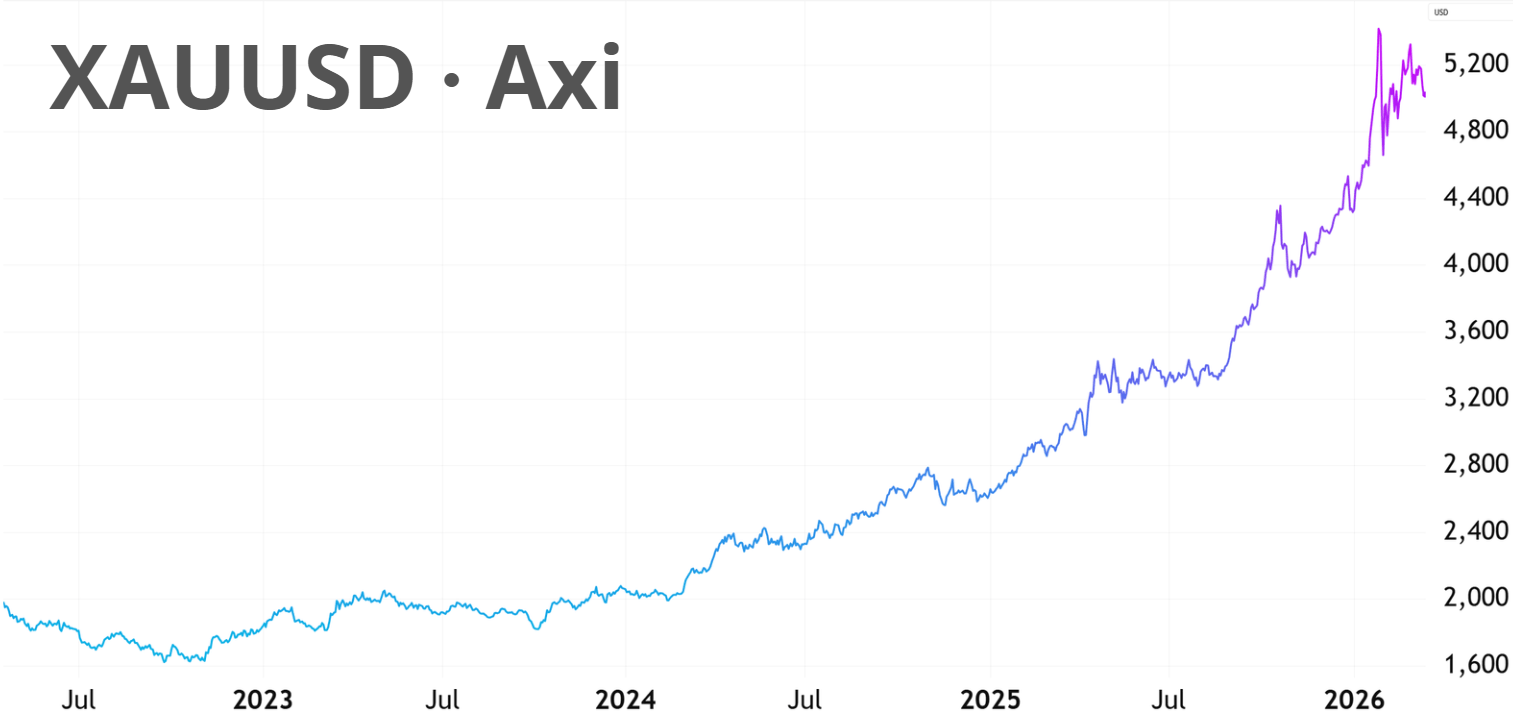
Gold has repeatedly risen to new highs in response to economic uncertainty and monetary policy changes. Most recently, gold reached an all-time high at the end of January 2026, fuelled by strong demand for safe-haven assets and continued central bank accumulation. Current demand is notably structural, with supply only growing by approximately 1%–2% annually.
Demand has remained high through times of ongoing geopolitical tensions and uncertainty in global trade, particularly developments in US-China relations. During times of market stress or macroeconomic instability, investors frequently turn to gold as a store of value, which can support rising prices.
Central banks have also played an important role in stabilising gold prices. Countries such as Poland, India, and Turkey have continued to increase their gold reserves as part of broader diversification efforts. This trend has accelerated as nations seek assets without counterparty risk, with central bank purchases now consistently exceeding 1,000 tonnes annually. Sustained government and central bank purchases have strengthened gold's position as a strategic reserve asset in the global financial system.
Gold prices fluctuate based on inflation trends, central bank decisions, and global stability, often moving inversely to the US dollar.
After hitting an all-time high on January 29, 2026, gold suffered a violent 20% correction when President Trump nominated the hawkish Kevin Warsh for Fed Chair. The move effectively cooled expectations for aggressive rate cuts this year.
Despite this "hawkish scare", gold proved resilient, rebounding from a $4,400 floor to surpass $5,200 by late February, fuelled by structural demand, global volatility, and looming tariff concerns.
Traders often use Gold CFDs or ETF CFDs to navigate these rapid price swings with higher liquidity than physical bullion.
For real-time gold pricing and up-to-the-minute market data, view our live gold price chart.
Since ancient times, gold has been valued for its beauty and rarity. Before 1971, gold anchored money under gold standards, with fixed prices but periodic adjustments. During the 19th century, many countries adopted the gold standard, directly tying their currencies to gold. This period was characterised by relatively stable prices and fixed exchange rates.
The establishment of the Bretton Woods Accord in 1944 significantly impacted gold prices. Under this system, currencies were pegged to the US dollar, which itself was backed by gold at a fixed rate of $35 per ounce.
In 1971, the "Nixon Shock" ended the Bretton Woods system, allowing gold prices and exchange rates to fluctuate freely. This shift transformed gold from a fixed anchor into a speculative asset. At that time, gold traded at $43.15 per ounce.
In January 1980, gold reached $850 per ounce, driven by high inflation and geopolitical tensions, including Iran, before the Fed Chair's aggressive rate hikes (to 20%) crushed inflation and triggered a 20-year bear market to $252 lows in 1999.
Following 9/11 in 2001 and due to the global financial crisis, demand for gold was reignited, peaking over $1,900 per ounce in September 2011 as investors sought safe-haven assets.
A correction followed until December 2015 lows of to $1,050 lows amid Fed tapering (the gradual reduction of the Fed’s bond-buying program aimed at stimulating the economy). Gold went on to stabilise in the $1,200-$1,800 range throughout 2019, pressured by rising interest rates and economic growth.
In August 2020, gold prices exceeded $2,000 per ounce, supported by economic uncertainty, fiscal stimulus, and low interest rates. before entering a grinding multi-year downtrend and sideways range, amid rising rates and economic recovery optimism.
COVID fears and aggressive Fed tightening kept gold rangebound until the October 2023 breakout above $2,000 signalled the next bull leg.
In October 2023, gold broke out above $2,000, climbing close to 180% gains to around $5,300 by February 2026, despite sharp pullbacks, including a steep drop in January.
Year |
Average rate per ounce |
1833-49 |
$18.93 |
1945 |
$34.71 |
1972 |
$58.42 |
1975 |
$160.86 |
1979 |
$306 |
1980 |
$615 |
2010 |
$1,224.53 |
2020 |
$1,773.73 |
2022 |
$1,801.87 |
2023 |
$1,934.86 |
2024 |
$2,389 |
2025 |
$3,446 |
Source |
2026 |
2027 |
2030 |
2040 |
2050 |
Deutsche Bank |
$6,000 | $5,150 | * | * | * |
JP Morgan Chase & Co |
$6,300 | $5,400 | $8,000 - $8,500 | * | * |
Goldman Sachs |
$5,400 | $5,600+ | $6,200 | * | * |
InvestingHaven |
$5,750 | $6,500 | $8,150 | * | * |
Peter Schiff |
$6,000 | * | * | * | * |
TD Securities |
$5,455 - $5,700 | * | * | * | * |
UBS |
$5,900 | $6,200 (by Q1) | * | * | * |
Yardeni Research |
$6,000 | $8,000 | $10,000+ | * | * |
* Price prediction not provided from this source for this year
Forecasts about future performance may not occur.
For 2026, major financial institutions and analysts have significantly upgraded their outlooks, with price targets now ranging from $5,400 to $6,300 per ounce.
At the higher end, J.P. Morgan projects a target of $6,300, citing a "structural demand thesis" fuelled by sustained central bank accumulation of roughly 800 tonnes. Deutsche Bank, Yardeni Research, and Peter Schiff all align on a $6,000 milestone, while UBS forecasts a peak of $5,900 following the US midterm elections.
Meanwhile, Goldman Sachs maintains a $5,400 target, basing its optimism on continued "de-dollarisation" and private-sector diversification. Despite varying levels, there is a clear consensus among forecasters: gold is in a momentum phase where demand is outpacing mine supply.
For 2027, the outlook remains structurally bullish, with targets spanning from $5,150 to $8,000 per ounce.
Yardeni Research holds an aggressive view at $8,000, viewing it as a warning against fiscal policy uncertainty. InvestingHaven follows with a $6,500 target, citing a secular bull market confirmed by 50-year chart patterns. Goldman Sachs and J.P. Morgan offer targets of $5,600 and $5,400, respectively, emphasising macro risk hedging and inelastic central bank demand. Deutsche Bank sets a floor for the year at $5,150, noting that while prices may consolidate, the return of ETF inflows provides a strong technical backstop.
Ultimately, these forecasters agree that 2027 will likely be a year of "structural support", where gold stabilises at a significantly higher base due to the permanent erosion of confidence in traditional fiat reserves.
By 2030, long-term projections suggest gold could reach unprecedented levels, often cited between $6,200 and over $10,000 per ounce.
Yardeni Research presents an ambitious outlook at $10,000+, framing this as a policy-driven "supercycle”. InvestingHaven forecasts $8,150, based on a multi-stage bull market and rising inflation expectations. J.P. Morgan also targets the $8,000-$8,500 range, modelling an upside scenario driven by higher household gold allocations. Goldman Sachs maintains a more anchored view at $6,200, emphasizing safe-haven accumulation through the remainder of the decade.
Despite the variance in specific price targets, these forecasters converge on a central theme: gold is undergoing a fundamental revaluation driven by deep-seated changes in the global monetary environment, rather than temporary cyclical factors.
Long-term projections for gold in 2040 often rely on historical rate-of-return models. David Harper has suggested that gold could reach higher price levels, such as $6,800, by 2040 based on historical performance analysis. His methodology compares long-term holding periods to estimate average annual returns, using a 7% geometric mean return based on the 1971-2010 period.
Looking until 2050, some outlooks focus on supply constraints. Research in Trends in Ecology and Evolution has suggested that increasing scarcity of essential metals, including gold, could influence prices. This "World Run Out" scenario refers to USGS estimates regarding "peak gold" (extractable gold reserves vs. demand). Investor Robert Kiyosaki has also argued that if confidence in traditional systems erodes, gold may play an increasingly important role in the future of the monetary system.
Short-term price predictions for gold suggest an increase in its value and demand in the next years, at least until 2030, showing the price could gradually rise to around $8,000 an ounce.
But price predictions beyond this date could depend on different scenarios. Ultimately, when it comes to long-term forecasts, there are fundamental questions to consider regarding the importance of safe-haven assets like gold in an ever-changing financial landscape.
A price prediction, or “forecast”, can be a useful tool to help you navigate the complex world of commodity trading. Although price predictions are speculative by nature and cannot guarantee accuracy, they can help market participants manage price risk and create hedging strategies.
Major banks and financial data providers use a combination of historical data analysis, fundamental analysis, technical analysis, and economic indicators to create price forecasts for different asset classes and commodities.
Ready to trade your edge?
Join thousands of traders and trade CFDs on forex, shares, indices, commodities, and cryptocurrencies!
References to forecasts and past performance are not reliable indicators of future results.
The images shown are for illustration purposes only. Data is sourced from third-party providers.
This information is for educational purposes only and is not intended to be financial product advice or any investment recommendation. It is not to be construed as a recommendation; or an offer to buy or sell; or the solicitation of an offer to buy or sell any security, financial product, or instrument; or to participate in any trading strategy. It has been prepared without taking your objectives, financial situation and needs into account. Axi makes no representation and assumes no liability with regard to the accuracy and completeness of the content in this publication. Readers should seek their own advice.
FAQ
Whether gold is a suitable investment depends on your individual circumstances. It is commonly used for diversification and as a store of value, but it does not generate income and its price can rise or fall.
A range of economic factors influence gold prices. When real interest rates fall, the opportunity cost of holding non-yielding gold decreases, often supporting higher prices. The price of gold may also rise if central banks continue to increase their bullion holdings and geopolitical risks intensify. Conversely, gold prices may come under pressure if the US dollar strengthens and geopolitical tensions ease.
Gold prices are primarily influenced by inflation, interest rates, and the strength of the US dollar. A weaker dollar supports gold prices, while a stronger dollar may decrease demand from international investors. Central bank policies and lower interest rates also contribute to higher gold prices by minimising the opportunity cost of holding non-yielding assets. Additionally, the scarcity of gold plays a crucial role in maintaining its value.
For many, Gold CFDs or ETF CFDs are preferred for their efficiency and liquidity. Unlike physical bullion, which involves storage concerns, CFDs allow for immediate exposure to price movements.

